
Spousal Sponsorship
The Complete Guide to Spousal Sponsorship in Canada [2025]
Bringing your loved one to Canada should be a straightforward and rewarding experience, but navigating spousal sponsorship can feel overwhelming. Whether you’re just beginning or facing unexpected challenges, this guide will break everything down into simple, practical steps, ensuring your sponsorship journey is as smooth as possible.
What Is Spousal Sponsorship?
Spousal sponsorship is an immigration program that allows Canadian citizens and permanent residents to sponsor their spouse, common-law partner, or conjugal partner to become permanent residents of Canada. The goal? Keeping families together by eliminating long periods of separation.
Why Does Canada Offer Spousal Sponsorship?
Canada believes in family reunification—it’s one of the core principles of the country’s immigration system. This program exists to ensure that couples can live together without being forced apart due to visa restrictions. The process is designed to be faster than other immigration pathways because the government recognizes how crucial it is for spouses to be together.

Why Spousal Sponsorship Is a Game-Changer
This isn’t just about paperwork—it’s about bringing families together and providing stability for couples. Here’s why spousal sponsorship is one of the most sought-after immigration programs:
✔ Permanent Residency for Your Spouse
Once the application is approved, your partner becomes a permanent resident of Canada, giving them full rights to live, work, and study anywhere in the country. They’ll also have access to healthcare and other social benefits.
✔ Faster Processing Than Other Family Sponsorship Programs
Spousal sponsorship applications are given priority over other family immigration applications.
- Inland sponsorships (for spouses already in Canada) usually take 12 to 18 months.
- Outland sponsorships (for spouses applying from abroad) can be even faster, sometimes under 12 months.
✔ Flexibility in Application Type
- If your spouse is already living in Canada, they can apply under the inland sponsorship category.
- If they’re outside Canada, they can apply through the outland sponsorship stream, which often has shorter processing times.
✔ Work While Waiting
Inland applicants can apply for an open work permit, meaning they won’t have to wait for PR approval to start working in Canada.
📌 Interesting Fact: More than 60,000 spouses and partners become permanent residents through this program every year.
Who Can Sponsor?
If you are a Canadian citizen or Canadian permanent resident, you will be eligible to sponsor your spouse under certain conditions, such as:
- Must be 18 years of age or older
- Must be legally married
- Demonstrate that your marriage is genuine – this is one of the most important factors (details below)
- Must not be receiving social assistance, other than disability
- Demonstrate sufficient income and/or funds to provide for your family, including your spouse and accompanying children. Generally, there is no income requirement, so it is important to assess your situation carefully to determine if you can satisfy the requirement for financial support.
- If you were previously sponsored by a relative, you must wait 5 years from the date you obtained permanent resident to be eligible to sponsor
For many, this is the only route available to bring their spouse to Canada and obtain permanent residency. The good news is that the requirements for the applicant is much lower than other routes to permanent residency, such as Express Entry. If your spouse has children, they can be included in the sponsorship application. The sponsored spouse is referred to as the “Applicant”
Who Can Be Sponsored?
✔ Must be legally married to the sponsor
✔ The marriage must be valid under Canadian law (and recognized in the country where it took place)
✔ Must have lived together for at least 12 consecutive months in a marriage-like relationship
✔ Proof of shared finances, bills, and housing is required
✔ A relationship of at least 1 year, but legal or immigration barriers have prevented the couple from living together
✔ Requires strong evidence that cohabitation was not possible
Inland vs. Outland Spousal Sponsorship
There are two (2) types of applications available if you are sponsoring your spouse, depending on whether the applicant is residing outside Canada or inside Canada. Both applications have their advantages and disadvantages, depending on your circumstance. Spousal sponsorship applications are paper-based and cannot be submitted online.
Inland Common Law Sponsorship
If you are residing inside Canada under a temporary resident status such as visitor, worker, or student, you may apply under the Inland Spousal Sponsorship route.
The main advantage in applying from inside Canada is that you will qualify for an open work permit. This will allow you the opportunity to work for any employer while your spousal sponsorship application is being processed. You may submit the work permit application together with your spousal sponsorship application. If approved, the open work permit will be issued to the applicant halfway through the application processing time (approx. 6 months), so you do not have to wait the entire processing period.
Other advantages in applying for spousal sponsorship inside Canada include:
- If your temporary resident status is expiring, you will maintain implied status until a decision is rendered, so long as you submit the spousal sponsorship application before your temporary resident status expires
- Application processing times from inside Canada are generally faster since the application remains inside Canada
- Applicants residing inside Canada have the option to use the Outland Spousal Sponsorship application
TIP: if you are residing inside Canada and are out of status, you may still be eligible to be sponsored. However, without valid status, you do not qualify for an open work permit.
Disadvantages of using the Inland Spousal Sponsorship application include:
- You will not be allowed to exit Canada while the sponsorship application is being processed. If you exit Canada and attempt to re-enter, the officer may refuse your entry. This will result in your application being refused and thus you must restart the entire process from outside Canada.
- You must be living together with your spouse for the duration of the application process
- There is no opportunity to appeal the decision to the Immigration Appeal Division. The only option would be to apply for judicial review in Federal court, which can be a lengthy and expensive process.
Inland Sponsorship
This pathway is designed for spouses who are already living in Canada with the sponsor. Here are its key features:
- Residency Requirement: Your spouse must physically reside in Canada while the application is processed.
- Open Work Permit Eligibility: Inland sponsorship allows applicants to apply for an open work permit, enabling them to work legally in Canada while waiting for their permanent residency approval.
- Travel Restrictions: Your spouse should avoid leaving Canada during the application process, as re-entry may not be guaranteed.
- Suitability: Ideal for couples who are already living together in Canada and do not anticipate international travel.
Outland Common Law Sponsorship
The main advantage of using the Outland Spousal Sponsorship application is that you will be able to exit and enter the country while the application is being processed. For applicants who have commitments abroad such as family or employment, they are free to attend to their commitments, while also having the option to remain with their spouse in Canada.
Other advantages in applying for spousal sponsorship outside Canada include:
- If you have submitted your application and are denied entry into Canada, your application will not be affected
- You are not required to reside together with your spouse
- If your spousal sponsorship application is refused, you have the option to appeal the decision to the Immigration Appeal Division
Disadvantages of using the Inland Spousal Sponsorship application include:
- You are not eligible to apply for an open work permit
- If you are inside Canada, you must maintain your temporary residence status. Unlike Inland Spousal applications, you will not be given implied status.
- While your application is being processing, you may be requested to attend an interview by an immigration offer to verify certain components of the application. Since Immigration Canada assumes you are outside Canada, the interview location may be scheduled in your country of citizenship or current country of residence.
- Processing times are generally longer since the application may be transferred and processed through the visa office in your country of origin or country of residence
Inland vs. Outland Sponsorship: A Quick Comparison
|
Criteria |
Inland Sponsorship |
Outland Sponsorship |
|---|---|---|
|
Applicant Location |
Must reside in Canada |
Resides outside Canada |
|
Work Permit Option |
Eligible for an open work permit |
Work permit not available |
|
Processing Times |
May take longer |
Generally faster |
|
Travel Restrictions |
Should stay in Canada |
Free to travel internationally |
Pro Tip: Choose Inland Sponsorship if your spouse is already in Canada and does not plan to travel. Opt for Outland Sponsorship if your spouse is outside Canada or has travel commitments.
Genuineness of Relationship
Couples must demonstrate to the immigration officer that you are a loving, committed couple and did not enter the relationship to obtain permanent residency status in Canada. Immigration officers will assess this component through reviewing your documents and through an interview process.
If you have been in a short-length relationship and/or were married shortly prior to submitting your application, the genuineness of your relationship must be strong and convincing.
How Can You Demonstrate Genuineness?
Depending on the length and nature of your relationship, examples of evidence supporting a genuine relationship include:

Communication between you and your partner (phone records, text messages, emails, love letters, etc.)
There is a limit to the amount of communication you may submit in support of your application. As such, you should select the most honest and sincere communications throughout the length of your relationship. Ideally, the communications should not be all recent but taken throughout the length of your relationship.
Photos
Joint Documents
Application Process
Step 1: Eligibility
Before starting, you must determine if you are eligible to sponsor and your partner is eligible to be sponsored.
Once you determined that you meet the eligibility requirements, the next step is to gather your documents. There are mandatory documents which must be provided, such as marriage certificate, police clearance(s), birth certificate(s) and genuineness documents.
IRCC provides applicants with a document checklist, listing the required documentation for the application. However, just because you provide the required documents does not guarantee an approval. Every case is unique and must be individually assessed to determine the potential areas of weakness; and to properly address those areas of weakness to give you the best chances of success.
Step 3: Application Forms
There are several application forms to complete with this application. It is important that these application forms be fully complete with accurate and truthful information. Any missing information or discrepancy in the forms may be returned and deemed “incomplete” or may lead to a refusal. If there is a suspicion of untruthfulness or intention to mislead the immigration officer, you may be charged with misrepresentation, which results in an automatic 5-year ban.
Step 4: Application Fees
The breakdown of the application fees is:
- Sponsorship Fee $550CAD
- Right of Permanent Residence Fee $500CAD
- Include a dependent child with your spouse $150CAD per child
- Biometrics $85CAD per person (over 18 years of age)
If you are applying for Inland Spousal Sponsorship, your application will be submitted to the visa office in Misssisauga, Ontario.
If you are applying for Outland Spousal Sponsorship, your application will be submitted to the visa office in Sydney, Nova Scotia.
Once the application is submitted, the application will go through a two-phase process.
The first phase is called the completeness check. The immigration officer will verify that all required forms and documents were properly submitted and that the fees were paid. If you failed to provide any of the above-mentioned items, then the application will be returned.
The second phase is called eligibility review. The reviewing officer will assess and provide a letter determining whether Paola and Gonzalo meet the sponsorship requirements. At this stage, the reviewing officer may request further supporting documentation if any clarification is needed before he/she makes a final determination.
What Documents Are Needed for Spousal Sponsorship Application?
Every application needs strong supporting evidence to prove the legitimacy of the relationship. Here’s a breakdown:
✔ Identity & Status Documents – Passports, birth certificates, and proof of Canadian status for the sponsor.
✔ Proof of Relationship – Marriage certificates, joint leases, shared financial records, family photos, chat logs, and travel records.
✔ Supporting Forms – Completed IMM 5532 (Relationship Questionnaire) and IMM 5289 (Sponsorship Agreement).
✔ Police Certificates – Background checks from every country your spouse has lived in for six months or more since the age of 18.
✔ Medical Exam – Required for the sponsored spouse before PR approval.
📌 Pro Tip: Applications are often delayed due to missing documents. A well-prepared submission speeds up processing and reduces the risk of rejection.
Common Reasons for Sponsorship Refusals
Even though spousal sponsorship is a straightforward process, mistakes can lead to refusals. Here are some of the most common reasons applications get rejected:
🚨 Lack of Proof of Genuine Relationship
✔ Insufficient evidence of your relationship (photos, messages, joint financials) can cause concerns.
✔ IRCC may request additional proof or even schedule an interview.
🚨 Sponsor’s Ineligibility
✔ If the sponsor is in bankruptcy, on social assistance (excluding disability), or does not meet the eligibility criteria, the application may be denied.
🚨 Missing or Incorrect Forms
✔ Applications that contain errors or are missing required forms will face processing delays—or worse, rejection.
🚨 Medical or Criminal Inadmissibility
✔ If the sponsored spouse has serious medical conditions or criminal convictions, this can lead to complications. You might need to apply for a Temporary Resident Permit and/or Criminal Rehabilitation.
📌 How to Avoid Refusal: Double-check every document and work with an expert if needed to strengthen your application before submitting.
How We Can Help You Get Approved
Spousal sponsorship is one of the fastest ways to bring your loved one to Canada, but getting it right the first time is crucial. We specialize in sponsorship applications, ensuring:
✔ Your application is complete and free of errors
✔ Strong supporting documents that prove the authenticity of your relationship
✔ Quick responses to IRCC requests to prevent delays
📞 Don’t risk unnecessary delays or refusals—contact us today and let’s get your spouse to Canada as fast as possible!
Who Can Sponsor? Requirements Breakdown
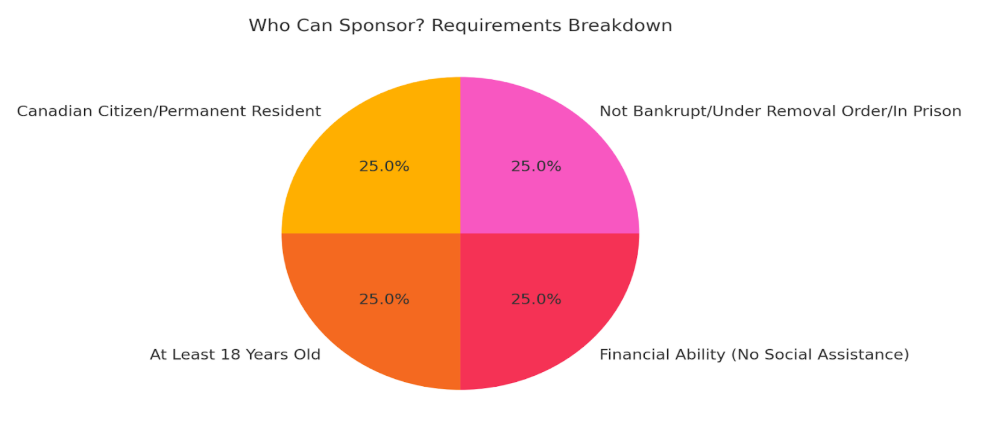
If you’re a permanent resident of Canada, it’s crucial to remember that you must live in Canada to sponsor your spouse. This requirement ensures that you maintain your ties to the country and fulfill your obligations as a sponsor.
Who Can Be Sponsored?
Canada’s spousal sponsorship program allows you to sponsor your significant other, but eligibility is determined based on strict criteria. These rules are designed to promote family reunification while safeguarding the integrity of the immigration system. Below are the three categories your partner must fit into to qualify:
- Spouse
A spouse refers to someone you are legally married to under the laws of the country where the marriage took place. Canada recognizes marriages performed abroad, provided they are valid in the country of origin. If your marriage is valid there, it’s valid here too.
Example: Emily and James tied the knot in a beautiful ceremony in Italy. They obtained an official Italian marriage certificate, which Canada recognizes, making James eligible for sponsorship.
- Common-law Partner
A common-law partner is someone you’ve lived with in a committed, marriage-like relationship for at least 12 consecutive months. This isn’t a ballpark figure—you need to prove you’ve shared a home and life for a full year. Evidence such as joint leases, shared utility bills, and affidavits from family or friends can help substantiate your claim.
Example: Priya and Ahmed have shared a Toronto apartment for over 14 months. They have a joint rental agreement and a shared bank account, qualifying Ahmed as a common-law partner.
- Conjugal Partner
This Conjugal Partner category is for couples who cannot marry or live together due to extraordinary circumstances, such as restrictive laws, cultural norms, or other barriers. You must demonstrate that your relationship is authentic and ongoing despite these obstacles. Expect to provide ample evidence, such as travel itineraries, financial transfers, or consistent communication records.
Example: Fatima and Alex maintain a long-distance relationship because Fatima’s home country forbids relationships like theirs. They’ve kept their bond strong through regular visits, financial support, and daily communication, making Fatima eligible as a conjugal partner.
Eligibility Challenges in Spousal Sponsorship
Even if your partner meets the basic eligibility criteria, certain situations can complicate their application. Here are some common red flags:
Previous Sponsorship Bans
If you’ve sponsored a spouse, common-law, or conjugal partner in the past, you cannot sponsor another partner for five years. This rule helps deter misuse of the program and ensures genuine sponsorship intentions.
Example: Sarah sponsored her first husband in 2020, but they divorced in 2022. Under Canadian law, she must wait until 2025 before she can sponsor her new partner, Liam.
Criminal Records or Security Concerns
If your spouse has a criminal record or poses a security risk, their application may be denied. Rehabilitation options exist, but these cases require additional documentation and time.
Misrepresentation in Spousal Sponsorship Applications: What You Need to Know
Misrepresentation is one of the most serious issues that can arise during the spousal sponsorship application process. It occurs when an applicant or sponsor provides false, incomplete, or misleading information to Immigration, Refugees, and Citizenship Canada (IRCC). The consequences of misrepresentation can be severe, affecting not only the application but also your ability to sponsor or immigrate in the future. Let’s delve deeper into what constitutes misrepresentation, its consequences, and how to avoid it.
What is Misrepresentation?
Misrepresentation involves providing inaccurate or deceptive information, either intentionally or unintentionally, during the sponsorship application process. This includes omissions, exaggerations, or falsifications in forms, documents, or interviews.
Examples of Misrepresentation:
- False Documents: Submitting fake marriage certificates, altered travel records, or fabricated financial documents.
- Omitting Relevant Information: Failing to disclose a previous marriage, dependent children, or a criminal record.
- Inconsistent Details: Contradictions between application forms and supporting documents, such as mismatched dates or timelines.
- Misleading Relationship Evidence: Providing photos or letters that don’t accurately represent the relationship’s authenticity.

Consequences of Misrepresentation
Misrepresentation has severe and long-lasting consequences under Canadian immigration law. Here’s what can happen if IRCC identifies misrepresentation in your application:
1. Sponsorship Ban:
-
- The sponsor may be barred from sponsoring another individual for five years.
- If the misrepresentation was on the part of the sponsored individual, they may be banned from entering Canada for five years.
2. Application Refusal:
-
- The entire spousal sponsorship application will be denied, requiring you to start over, which can lead to significant delays and additional costs.
3. Loss of Status:
-
- If the misrepresentation is discovered after approval, the sponsored individual’s permanent resident status may be revoked, leading to deportation.
4. Damage to Credibility:
-
- Future immigration applications will be subject to heightened scrutiny, making it more challenging to navigate Canada’s immigration system.
Common Scenarios Leading to Misrepresentation
- Failure to Disclose Prior Marriages:
- IRCC requires full disclosure of all previous marital relationships. Failing to mention a divorce or annulment can raise red flags.
- Example: A sponsor conceals a prior marriage, thinking it’s irrelevant. IRCC discovers this during background checks, leading to an application denial.
- Exaggerating Financial Stability:
- Providing inflated income figures or fake job letters can backfire if IRCC requests additional proof, such as tax returns or pay stubs.
3. Incomplete Travel History:
-
- Omitting countries visited, even for short vacations, may be viewed as an attempt to hide something.
4. Fake or Staged Relationship Evidence:
-
-
- Photos that appear overly staged, fabricated communication logs, or affidavits from family members that don’t align with other evidence can all lead to misrepresentation claims.
-
How to Avoid Misrepresentation
- Be Completely Honest:
- Accuracy and transparency are non-negotiable. If you’re unsure about how to answer a question, consult a professional to ensure you provide truthful and complete information.
- Double-Check Your Application:
- Review every form, timeline, and document to ensure consistency. Any discrepancies, even unintentional ones, can raise red flags.
- Provide Comprehensive Evidence:
- Avoid over-reliance on one type of proof (e.g., photos). Submit a well-rounded package, including financial records, communication logs, and affidavits.
- Address Potential Concerns Upfront:
- If there’s anything unusual about your application (e.g., significant age difference, long-distance relationship), include an explanatory letter with supporting evidence.
- Seek Professional Guidance:
- Work with an experienced immigration consultant or lawyer who can help you navigate the application process and avoid mistakes that could lead to misrepresentation.
What to Do If You’re Accused of Misrepresentation
If IRCC accuses you or your spouse of misrepresentation, you’ll likely receive a Procedural Fairness Letter (PFL). This letter gives you an opportunity to explain or correct the issue before a final decision is made.
Steps to Take:
- Review the Letter Carefully:
- Identify the specific concerns raised by IRCC.
- Gather Additional Evidence:
- Provide documents or affidavits to clarify the issue.
- Draft a Detailed Response:
- Address each point in the PFL, providing explanations and evidence to refute the allegations.
- Seek Professional Assistance:
- Misrepresentation cases are complex and high-stakes. Consult an immigration professional to ensure your response is effective.
Misrepresentation is a serious issue with significant consequences, but it’s entirely avoidable with careful preparation and transparency. Always provide accurate information, double-check your application, and include comprehensive evidence to back up your claims. If you’re unsure about any aspect of your application, seek professional advice—prevention is always better than dealing with the aftermath. By staying honest and meticulous, you can pave the way for a successful spousal sponsorship process.
Ensuring a Strong Application
Preparing a comprehensive, evidence-backed application is the best way to avoid delays or refusals. Whether you’re sponsoring a spouse, common-law partner, or conjugal partner, make sure you include:
- Legal proof of your relationship, such as marriage certificates or cohabitation records.
- Evidence of your shared life, like financial statements or travel records.
- Detailed explanations for any potential red flags, backed by supporting documents.
Spousal sponsorship is a meaningful pathway for family reunification, but it requires careful planning and compliance with Canada’s immigration regulations. By meeting all the eligibility requirements and avoiding common pitfalls, you can successfully bring your loved one to Canada and start building a life together.
Incomplete or misleading evidence of your relationship can derail your spousal sponsorship application. Immigration, Refugees, and Citizenship Canada (IRCC) examines each application closely to ensure relationships are genuine. A lack of sufficient documentation or inconsistencies in your evidence can raise red flags, resulting in delays or outright rejection.
Common Pitfalls in Relationship Evidence
Here’s where many applicants go wrong:
1. Insufficient Documentation
Submitting a small set of photos or incomplete financial records often isn’t enough. While pictures capture moments, they don’t necessarily prove a long-term, committed relationship. For instance, if you provide only photos without supporting travel receipts or communication logs, it leaves gaps in your story.
Example: John and Maria submitted a few photos from a vacation but neglected to include their travel itineraries or receipts. Without additional proof of shared experiences, IRCC questioned the authenticity of their relationship.
2. Inconsistent or Contradictory Evidence
Timelines that don’t add up, mismatched details between forms and supporting documents, or discrepancies in personal declarations can all undermine your credibility. IRCC compares your application’s details with the evidence provided, and any inconsistencies can lead to delays or denials.
3. Over-Reliance on Personal Statements
While heartfelt declarations of love are important, they need to be backed up by tangible proof. Affidavits from family and friends, joint bank account statements, shared lease agreements, and consistent communication records provide external validation of your relationship.
How to Build a Strong Case
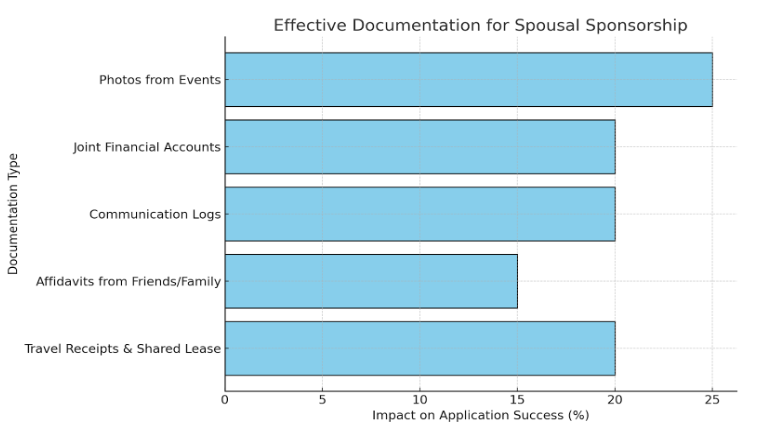
To ensure your spousal sponsorship application is successful, your evidence should present a clear, consistent, and multi-dimensional narrative of your relationship. Here’s what you need to focus on:
- Diverse Documentation
Provide a mix of evidence that covers different aspects of your relationship, such as:
- Photos from multiple occasions: Include images from vacations, family gatherings, and milestones, showing interaction with friends and family.
- Joint financial accounts: Bank statements, shared credit card accounts, or utility bills in both names demonstrate financial interdependence.
- Communication logs: Screenshots or printouts of call records, chats, or emails that showcase consistent contact, especially for long-distance relationships.
- Travel evidence: Tickets, itineraries, and receipts proving shared trips or visits.
- Consistent and Cohesive Timelines
Ensure the dates and events mentioned in your application align with your evidence. For example, if you claim you’ve lived together for 12 months, your lease agreements, utility bills, and joint mail should confirm this.
- External Validation
Third-party documentation strengthens your case. Letters or affidavits from family, friends, or employers who are familiar with your relationship add credibility. For example, a letter from a family member describing your wedding or joint activities can provide valuable context.
Example of Comprehensive Evidence
Priya and Ahmed submitted the following:
- Wedding photos with family and friends in attendance.
- A shared lease agreement for their Toronto apartment.
- Joint bank statements showing shared finances.
- Screenshots of video call logs during long-distance periods.
- Affidavits from Priya’s parents and Ahmed’s siblings detailing their relationship timeline.
Their application was approved without delays because their evidence painted a complete and authentic picture of their relationship.
Whether you’re sponsoring a spouse, common-law partner, or conjugal partner, your application’s success hinges on the strength of your evidence. Keep these tips in mind:
- Show diversity: Include multiple types of documentation to cover different aspects of your relationship.
- Be consistent: Ensure all your forms, declarations, and supporting documents align without contradictions.
- Provide external proof: Affidavits and third-party validations add credibility to your claims.
A well-prepared application backed by clear and authentic evidence can significantly improve your chances of success. If you’re feeling overwhelmed by the process, professional guidance can help ensure your documentation is error-free, compelling, and aligned with IRCC’s expectations. By being thorough and proactive, you can avoid unnecessary delays and take a big step toward reuniting with your loved one in Canada.
For the Sponsor
1. Proof of Canadian Citizenship or Permanent Residency
-
- What it is: Documentation confirming your legal status in Canada.
- Examples: A copy of your Canadian passport, citizenship certificate, PR card, or Canadian birth certificate.
- Why it matters: IRCC requires evidence that you meet the legal criteria to act as a sponsor under Canadian immigration laws.
- Example: If you are a permanent resident, provide a clear photocopy of both sides of your PR card. Canadian citizens can include a scanned copy of their passport or citizenship certificate to meet this requirement.
2. Proof of Income
-
-
- What it is: Financial records that demonstrate your ability to support your spouse without relying on government assistance.
- Examples: Recent pay stubs, your most recent Notice of Assessment from the CRA, employment verification letters, or detailed bank statements.
- Why it matters: Although there is no specific income threshold for spousal sponsorship, IRCC evaluates your financial stability to ensure you can meet basic living expenses.
-
Example: Include at least six months of pay stubs and a formal letter from your employer verifying your salary, position, and job stability.
3. Signed Sponsorship Agreement
-
- What it is: A legally binding agreement between you and your spouse outlining your obligations during the sponsorship period.
- Why it matters: This agreement is a commitment to financially support your spouse for three years after they gain permanent resident status.
- Example: Complete and include the IMM 1344 form signed by both you and your spouse. This document is a mandatory part of the sponsorship package.
4. Declaration of Intent to Reside in Canada (if applicable)
-
- What it is: A formal statement that confirms your plan to return to or continue residing in Canada once your spouse becomes a permanent resident. This is essential if you’re currently living outside Canada.
- Examples: A letter of intent, a Canadian job offer, or proof of a Canadian address (e.g., lease or home purchase agreement).
- Why it matters: IRCC needs assurance that sponsors living abroad intend to return to Canada to fulfill their obligations.
Example: If you’re living in another country, provide evidence such as a signed job offer from a Canadian employer or proof of housing arrangements in Canada.
For the Applicant
- Passport or Travel Document
-
- What it is: Valid, government-issued identification required to confirm your identity and nationality.
- Examples: A copy of the biodata page of your passport or a travel document that meets international standards.
- Why it matters: IRCC uses this information to verify your personal details and citizenship.
- Example: Ensure your passport is up to date and provide a clear photocopy of the identification page.
- Marriage Certificate or Proof of Common-Law Relationship
- What it is: Documents proving the authenticity of your marital or partnership status.
- Examples: Marriage certificates, shared utility bills, joint bank accounts, lease agreements, or affidavits from people familiar with your relationship.
- Why it matters: IRCC requires proof that your relationship is genuine and legally recognized.
- Example: If legally married, include your marriage certificate. For common-law partnerships, provide at least one year of cohabitation evidence such as shared rent or utility payments.
- Police Certificates for All Countries of Residence Since Age 18
- What it is: Background checks from every country where you’ve lived for six months or more since turning 18.
- Examples: Official police clearance certificates or criminal record checks issued by local authorities.
- Why it matters: IRCC uses this information to assess whether the applicant is criminally inadmissible to Canada.
- Example: If you lived in the U.S., include an FBI clearance certificate along with any applicable Canadian or international police checks.
- Medical Exam Results from an IRCC-Approved Physician
- What it is: A health evaluation confirming you meet Canada’s medical admissibility standards.
- Examples: The completed medical examination form (IMM 1017E) provided by an IRCC-approved panel physician.
- Why it matters: IRCC needs assurance that you do not pose a public health risk or place excessive demands on the healthcare system.
- Example: Schedule your exam with a designated IRCC-approved doctor and submit the clinic’s receipt or confirmation.
- Proof of Prior Relationships Ending (if applicable)
- What it is: Documentation showing that any previous marriages or partnerships have been legally dissolved.
- Examples: Divorce decrees, annulment certificates, or death certificates.
- Why it matters: IRCC requires confirmation that there are no legal barriers to your current relationship.
- Example: Include certified copies of your divorce decree or annulment papers if you’ve been previously married.
Providing detailed and well-organized documentation is essential to streamline your spousal sponsorship process. The stronger your evidence, the smoother your application journey will be.
Tips for Preparing and Organizing Your Documents
- Create a Logical Structure
Organize your documents into clearly defined categories. For example, separate sponsor-related documents from those required for the applicant. Use labeled folders or sections to make it easy for IRCC officers to review your submission without confusion. - Follow IRCC’s Checklist
Use the official IRCC document checklist as your guide to ensure no required document is overlooked. Double-check every item on the list before finalizing your application package to avoid unnecessary delays caused by missing materials. - Include Certified Translations
If any of your documents are in a language other than English or French, make sure to include a certified translation. This step is crucial, as IRCC will not accept untranslated or uncertified documents, which can result in your application being returned or delayed.
4. Submit Clear and Legible Copies
All photocopies of documents should be sharp, easy to read, and free of obstructions like glare or shadows. Avoid submitting blurry scans, as IRCC requires clear documentation for verification purposes.
5. Bundle Documents by Category
Group related documents together, such as financial records, identification materials, or relationship evidence. Presenting them in a cohesive order makes it easier for officers to process your application quickly and efficiently.
6. Use Tabs or Dividers
If submitting a physical application, use tabs or dividers to separate different sections. This small organizational step can make a big difference in ensuring that nothing gets overlooked during the review process.
7. Double-Check for Completeness
Before submission, go through your entire package one more time to confirm that all required documents are included. Missing items are one of the most common causes of delays or rejections.
By taking the time to thoroughly organize and present your documents, you significantly increase the chances of a smooth and timely review. A clear, complete, and professional application package reflects your attention to detail and strengthens your case for approval.
Establishing Proof of Relationship
IRCC carefully evaluates relationships to ensure they are authentic and not entered into for immigration purposes. Demonstrating a genuine bond is key to a successful spousal sponsorship application. Here are some effective ways to build your case:
1. Photos from Different Events
Provide photos taken together over time, ideally from various occasions, locations, and with family or friends. This shows the progression and integration of your relationship into each other’s lives.
2. Financial Interdependence
Submit bank statements with joint accounts, shared credit card bills, or co-signed loan documents. These demonstrate financial trust and responsibility shared as a couple.
3. Communication Records
Include email exchanges, chat histories, and call logs that reflect consistent and meaningful communication. IRCC values evidence that shows ongoing emotional connection, especially during long-distance periods.
4. Affidavits from Supporters
Request letters from friends, family, or colleagues who know you as a couple. Their statements should detail their personal observations of your relationship and support its authenticity.
Sample Evidence Timeline
Here’s how to organize and present relationship evidence effectively:
|
Type of Evidence |
Examples |
When to Provide |
|---|---|---|
|
Communication |
Emails, chats, call logs |
Throughout relationship |
|
Financial Interdependence |
Joint accounts, shared bills |
During cohabitation |
|
Milestones |
Wedding photos, travel receipts |
During significant events |
Common Challenges in Spousal Sponsorship
1. Incomplete Documentation
This is the most frequent cause of delays or outright rejections. A missing document, like a signed form or proof of relationship, can undermine the authenticity of your application. Think of your application as a puzzle—every piece matters.
Example: Forgetting to include key evidence, such as joint utility bills or a marriage certificate, may lead IRCC to question your relationship’s legitimacy, delaying your application.
2. Inadmissibility Due to Medical or Criminal Issues
Past criminal records or medical conditions can seem like insurmountable barriers, but they aren’t. These situations often require additional documentation and proactive measures to resolve.
Example: Your spouse has a minor criminal conviction from a decade ago, potentially making them inadmissible. Without taking corrective action, this could lead to refusal.
3. Processing Delays
Waiting for updates from IRCC can be frustrating, especially when delays result from incomplete applications, missing biometrics, or simply high volumes of applications.
Example: If IRCC requests additional information and you respond late, this can stretch the timeline significantly. Missing a biometrics appointment, for instance, can push your processing time back by months.
Solutions: Turning Roadblocks into Success Stories
- Thorough Document Organization
A comprehensive checklist is your best ally. Go through IRCC’s official requirements carefully and ensure every document is in place before submission. Double-check forms for accuracy and completeness, making sure all signatures and information are correct.
Pro Tip: Create digital folders categorized by type, such as “Proof of Relationship” or “Sponsor Documents,” to ensure everything is accounted for. This system allows you to cross-reference quickly before submission. - Proactively Address Inadmissibility
For medical concerns, ensure your spouse undergoes a complete exam with an IRCC-approved physician. If there’s a criminal record, take action early:
- Temporary Resident Permit (TRP): This provides short-term access to Canada while your situation is being resolved.
- Criminal Rehabilitation: For a permanent solution, gather documents such as court records and proof of rehabilitation efforts. These can include community service records or evidence of a law-abiding lifestyle since the incident.
Example: If your spouse has a previous conviction, starting the rehabilitation process early and submitting comprehensive evidence can smooth the path to approval.
3. Monitor and Follow Up with IRCC
Keeping tabs on your application is crucial to avoid unnecessary delays. Use IRCC’s online tools, like the application tracker, to monitor progress and respond to requests promptly.
Pro Tip: Set up reminders to check for updates regularly. Respond to IRCC’s document requests within their specified timelines to avoid further delays.
4. Prepare for Delays in Processing
While processing times may vary, being patient and proactive helps. Inland applications typically take 12–18 months, while outland cases may take 9–12 months. By submitting a thorough, well-organized application, you can minimize the risk of delays.

Why Challenges Are Opportunities
Each challenge you face is an opportunity to demonstrate your dedication and preparedness. For example:
- Resolving inadmissibility shows your commitment to meeting Canada’s immigration standards.
- Submitting an organized, thorough application reflects your attention to detail and seriousness about joining Canadian society.
Taking the time to address potential issues upfront will strengthen your application and significantly increase your chances of success. Challenges, when approached with the right mindset, can pave the way for a stronger case and a smoother immigration journey.
With the right preparation and guidance, you can turn these obstacles into stepping stones toward a successful spousal sponsorship application.
Navigating the spousal sponsorship process may feel overwhelming, but with meticulous preparation and a proactive mindset, you can successfully tackle any challenges that come your way. Staying organized, addressing potential issues early, and responding promptly to requests can minimize delays and strengthen your case. Every step you take is a step closer to reuniting with your loved one in Canada. Together, we’ll turn this process into a seamless journey.
Tips for a Seamless Spousal Sponsorship Application
- Honesty is Non-Negotiable: Always provide accurate and truthful information. Misrepresentation can result in serious consequences.
- Stay Organized: Arrange your documents logically and ensure all forms are properly filled and signed.
- Monitor Application Progress: Regularly check IRCC’s online portal for updates and respond to requests without delay.
- Seek Expert Assistance: For complex cases, consider hiring an experienced immigration consultant to guide you.
Understanding Procedural Fairness Letters (PFL)
Receiving a Procedural Fairness Letter (PFL) from IRCC might feel intimidating, but it’s essentially their way of requesting clarification or additional evidence. This letter gives you an opportunity to address concerns and save your application from potential refusal.
Why IRCC Issues Procedural Fairness Letters
- Concerns About Relationship Authenticity
IRCC thoroughly examines relationships to ensure they are genuine and not entered into for immigration purposes. Common triggers for a PFL include:
- Suspicious Photos: Submitting staged or overly posed photos, such as a wedding with no guests or vacation pictures that appear unnatural, may raise red flags.
- Age or Cultural Gaps: A large age difference (e.g., 15+ years) or a relationship that contradicts cultural norms might require additional evidence to prove authenticity.
- Short Relationship Timelines: If your timeline appears rushed—such as meeting and marrying within weeks—IRCC may request proof of deeper connection.
- Lack of Shared Commitments: Missing evidence of joint assets, shared bank accounts, or cohabitation can lead to questions about the relationship’s legitimacy.
Example: A couple with a significant age gap could face scrutiny if their application lacks detailed communication records, joint financial documents, or affidavits from friends and family attesting to the relationship’s authenticity.
- Issues of Inadmissibility
- Criminal Records: Even minor offenses, like a DUI, can raise concerns about a spouse’s admissibility to Canada.
- Health Concerns: Medical conditions that may place a strain on Canada’s healthcare system, such as untreated chronic diseases, often require proof of management or treatment.
- Immigration Violations: Overstaying a visa, working without authorization, or submitting false information in past applications can trigger a PFL.
Example: A spouse with a DUI conviction from several years ago might need to provide certified court records, proof of completed rehabilitation programs, and evidence of good conduct since the incident.
- Inconsistencies or Missing Information
- Conflicting Dates: Discrepancies between stated timelines and supporting documents can raise doubts. For example, if you claim to have started your relationship in 2019 but only visited each other in 2021, IRCC may request clarification.
- Missing Evidence: Failure to provide police certificates, medical reports, or proof of cohabitation can stall your application.
- Errors in Forms: Even small mistakes, like an incorrect birth year or address, can result in a request for corrections.
Example: If you claim to have cohabited for two years but provide no joint lease or utility bills as evidence, IRCC may request further documentation to validate your claim.
How to Respond to a Procedural Fairness Letter
Receiving a PFL is not the end of the road. Here’s how to respond effectively:
- Stay Calm and Focused: Carefully read the letter to understand what IRCC is requesting.
- Gather Additional Evidence: Provide all the documents needed to address IRCC’s concerns. For example:
- Relationship proof: Photos, travel itineraries, or affidavits.
- Criminal records: Certified court documents and rehabilitation evidence.
- Medical conditions: Updated medical reports or treatment plans.
- Write a Detailed Explanation Letter: Use this opportunity to explain discrepancies, provide context, and clarify misunderstandings.
- Submit by the Deadline: Ensure all requested documents and explanations are submitted within the specified timeframe.
Why Procedural Fairness Letters Are a Second Chance
While a Procedural Fairness Letter (PFL) may seem daunting, it’s actually an opportunity to strengthen your case and provide missing details. By addressing IRCC’s concerns head-on and supplying comprehensive evidence, you can turn a potential obstacle into a successful outcome.
Facing challenges in your spousal sponsorship journey doesn’t have to mean defeat. With careful preparation, honest documentation, and timely responses, you can navigate this process confidently and move closer to reuniting with your loved one in Canada.
Preventing Procedural Fairness Letters: Proactive Strategies
- Thoroughly Review All Documents Consistency is key. Ensure dates, timelines, and declarations align across forms and evidence. Double-check for typos or missing details that could raise unnecessary questions.
- Provide Comprehensive Evidence Go beyond the basics. Include a variety of documents such as affidavits, timestamped photos, communication logs, and shared financial records. The more robust your evidence, the stronger your application.
- Address Potential Issues in Advance Anticipate concerns and explain them upfront. For example, if you had a private wedding with no photos, include a detailed explanation and supporting affidavits from attendees.
Responding Effectively to a Procedural Fairness Letter
- Act Quickly and Stay Calm Procedural fairness letters often come with a deadline (usually 30 days). Begin gathering the requested documents immediately to avoid delays.
- Tackle Each Concern Thoroughly Address every issue raised by IRCC with clear, organized evidence. For instance, if your relationship is under scrutiny, provide additional proof such as joint financial statements, travel records, or affidavits from friends and family.
- Craft a Persuasive Response Letter Write a detailed explanation that is respectful and factual. Outline how your evidence resolves the concerns raised. Use clear headings for each issue to make your response easy to follow.
- Consult an Expert A seasoned immigration consultant or lawyer can refine your response, ensuring it meets IRCC’s expectations and enhances your case.
Example: If IRCC doubts your relationship due to living apart, provide evidence like travel itineraries, video call logs, and letters from family members attesting to your connection.
What to Do After a Spousal Sponsorship Refusal
Receiving a refusal can feel devastating, but it’s not the end of the road. You have multiple options to address the situation and keep moving forward.
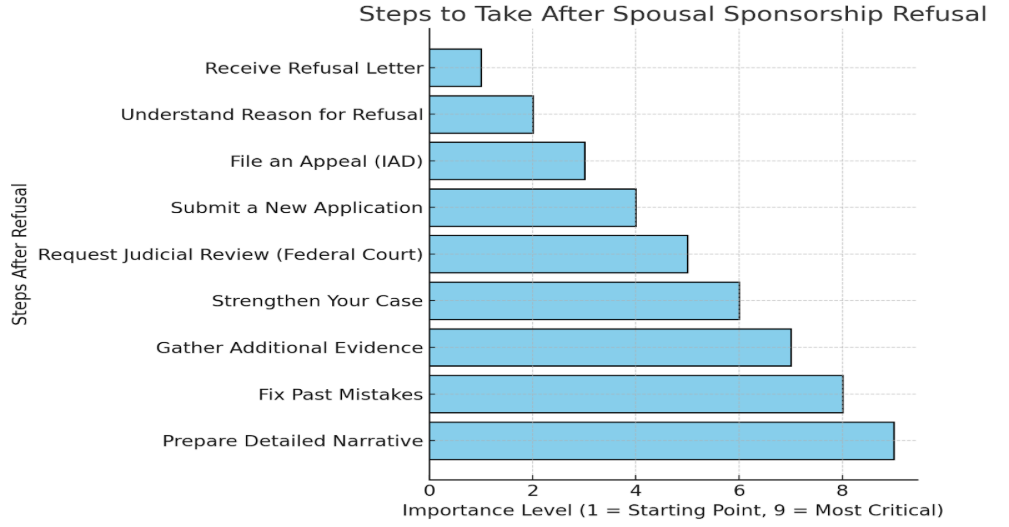
Step 1: Understand the Reasons for Refusal
Carefully review the refusal letter to identify why your application was rejected. Common reasons include:
- Incomplete Documentation Missing or insufficient documents, like police certificates or proof of relationship, often lead to rejections.
- Example: Submitting only a few photos without financial records may cause IRCC to question the depth of your relationship.
- Concerns About Relationship Authenticity IRCC may doubt your relationship if it lacks evidence of genuine commitment. Short dating periods, limited interaction, or no shared financial responsibilities can raise flags.
- Admissibility Issues Past criminal records, medical concerns, or financial instability can make your spouse inadmissible.
- Example: If your spouse has a DUI conviction, IRCC may request proof of rehabilitation efforts.
- Inconsistent or Conflicting Information Errors or mismatched details, such as conflicting timelines, can erode trust in your application.
Pro Tip: Categorize the reasons for refusal to prioritize your response effectively.
Step 2: Your Options After Refusal
- File an Appeal
- What It Is: Challenge IRCC’s decision by presenting new evidence or correcting errors.
- Where to File: Immigration Appeal Division (IAD).
- Timeline: Appeals must be filed within 30 days of the refusal notice.
- What Happens: During the hearing, you or your representative can present evidence to counter IRCC’s decision.
Example: If your relationship evidence was deemed insufficient, submit additional documents such as:
- Photos from family gatherings or daily life.
- Communication records like chats or call logs.
- Joint financial documents, such as shared bank accounts or utility bills.
Pro Tip: Appeals can take 6–12 months. Ensure your case is compelling and well-documented.
2. Submit a New Application If the refusal was due to minor issues like missing documents, reapplying may be a quicker option than appealing.
-
- What to Do Differently:
- Address all issues highlighted in the refusal letter.
- Include stronger, more diverse evidence.
- Double-check all forms for accuracy and completeness.
- What to Do Differently:
Example: If your application was rejected due to incomplete timelines, resubmit with corrected dates and a cover letter explaining the changes.
3. Request a Judicial Review If you believe the refusal was due to IRCC’s procedural errors, you can request a judicial review by the Federal Court.
-
- How It Works:
- The court examines whether IRCC followed proper procedures when assessing your application.
- Focuses on fairness rather than re-evaluating the evidence itself.
- Requires legal representation due to the complexity of the process.
- How It Works:
Example: If IRCC overlooked submitted evidence, such as police clearance certificates, a judicial review could prompt reconsideration.
Preventing Future Issues
Avoid refusals by taking a proactive approach:
- Submit a Complete Application: Double-check every form, timeline, and document.
- Provide Overwhelming Evidence: Go beyond the basics to prove the authenticity of your relationship and address any potential red flags.
- Stay Transparent: Be honest about any challenges, such as past criminal records or medical issues, and provide evidence of rehabilitation or treatment.
With careful planning and expert guidance, you can navigate the spousal sponsorship process successfully, even after a setback. Let us help you move closer to reuniting with your loved one in Canada.
Step 3: Reinforce and Fortify Your Application
No matter whether you decide to appeal, reapply, or request a judicial review, the strength of your case will determine your success. This stage is about presenting an airtight application that addresses any concerns raised previously while showcasing the authenticity and depth of your relationship. Here’s how you can make your case bulletproof.
- Expand Your Evidence Base
Providing thorough and varied evidence is crucial to eliminating any doubts about your relationship. Ensure your documentation paints a complete and compelling picture.
- What to Include:
- Photos capturing different milestones and moments—these could range from vacations and casual hangouts to weddings and birthday parties.
- Financial proof of your partnership, like joint bank account statements, utility bills in both names, and rental agreements.
- Communication records that show consistent interaction, including chat transcripts, emails, and call logs spanning your relationship.
- Letters from family and friends attesting to the authenticity of your connection. Affidavits can carry significant weight.
- Why It Works: A robust collection of evidence highlights the genuine nature of your relationship, addressing any previous IRCC concerns about authenticity or depth.
- Correct Previous Errors
A weak application often stems from mistakes or inconsistencies in submitted forms. This is your chance to fix any issues and present a flawless application.
- Steps to Take:
- Review every form thoroughly. Ensure timelines, dates, and details match across all sections.
- Replace any unclear or missing documentation. For example, if you initially left out travel receipts, now include them.
- Cross-reference the reasons in the refusal letter with your new submission to ensure all gaps are addressed.
- Why It Works: By eliminating discrepancies and inconsistencies, you demonstrate your commitment to the process and improve IRCC’s confidence in your case.
- Build a Detailed Personal Narrative
Crafting a strong narrative about your relationship gives IRCC a clearer understanding of your journey as a couple.
- What to Include:
- The story of how you met and how your relationship evolved, covering significant milestones.
- Challenges you’ve overcome, such as long-distance periods, cultural differences, or external pressures.
- Your future plans as a couple, whether that’s building a family, pursuing joint financial goals, or contributing to Canadian society together.
- Why It Works: A detailed, heartfelt explanation personalizes your application, making it more relatable and compelling for decision-makers.
Bonus Tip: Leverage Time in Canada
If your spouse is already in Canada during this process, use this period strategically.
- Actionable Steps:
- Strengthen your case by collecting evidence of shared activities and cohabitation.
- Build ties to the community, such as participating in local events or volunteering, which reflect your integration into Canadian society.
- Why It Matters: Highlighting your spouse’s contributions to Canadian life shows they are a valuable addition to the community, reinforcing the case for their permanent residency.
Final Thought: Be Persistent and Proactive
Strengthening your application is more than just adding documents; it’s about crafting a cohesive, well-documented case that leaves no question unanswered. By taking these steps, you significantly improve your chances of approval, whether you’re reapplying, appealing, or pursuing a judicial review. With careful preparation and an attention to detail, your application can make a lasting impression and bring you closer to reuniting with your loved one.
A spousal sponsorship refusal can feel like a significant hurdle, but it’s also an opportunity to present a more comprehensive and convincing application. By carefully understanding the reasons for refusal and adopting a strategic approach, you can overcome setbacks and reunite with your loved one in Canada. If the process feels overwhelming, consider seeking professional guidance to navigate the complexities and improve your chances of success.
Why Choose Visapath for Your Spousal Sponsorship Needs?
Spousal sponsorship applications are complex and require attention to detail, strategic planning, and thorough documentation. Akrami & Associates specializes in handling these challenges, offering expertise to help clients avoid mistakes and achieve their immigration goals.
At Visapath, we’ve turned countless immigration challenges into success stories. With extensive experience and a client-focused approach, we’ve helped thousands of families reunite and start new lives together in Canada.
Our firm has built a strong reputation for successfully handling spousal sponsorship cases, including those involving inadmissibility due to medical or criminal issues. For example, we’ve helped clients overcome refusals by gathering compelling evidence, including travel documents, joint financial records, and affidavits from family and friends.
One notable case involved a client whose application was rejected due to insufficient relationship proof. We worked closely with them to strengthen their case, ultimately winning their appeal and reuniting the family in Canada. This dedication to excellence is why so many clients Visapath.

What We Offer
- Personalized Case Assessments
Each case is unique. We take the time to understand your situation, identify potential challenges, and develop a tailored strategy to maximize your success.
- Expert Guidance
- We’ll manage your application, ensuring all forms are error-free and supported by comprehensive evidence.
- Our team will guide you in gathering essential documents like police certificates, medical records, and proof of cohabitation.
- Appeals and Refusals
If your application has been refused, we’ll help you file an appeal with the Immigration Appeal Division (IAD) or seek a judicial review to address the refusal.
- Overcoming Inadmissibility
- For criminal issues, we assist with Temporary Resident Permits (TRP) or Criminal Rehabilitation applications.
- For medical concerns, we help you present robust evidence to address IRCC’s concerns.
- Transparent Communication
We prioritize keeping you informed throughout the process, providing regular updates and maintaining open communication.
6. Comprehensive Support for Complex Cases
From building a solid application to navigating appeals, we handle every detail of the sponsorship process. For cases involving criminal inadmissibility or procedural fairness letters, we create tailored solutions to resolve issues and move applications forward.
7. Fighting for Clients Facing Refusals
If your application has been denied, our team specializes in appeals and judicial reviews. We’ll review the refusal letter, identify weaknesses in the original application, and craft a stronger case to present to the Immigration Appeal Division or Federal Court.
Ready to Get Approved? Let’s Talk.
How We Can Help
At Visapath, our representatives are highly experienced with Common Law Sponsorship and can guide you through each step of the process. Our representatives understand all the ins and out of sponsorships applications and can help you get into the mind of an immigration officer to ensure you compile a complete, strong and convicting application to give you the best chances of success.

If you are looking to sponsor your partner, please contact our office to schedule a consultation, and we will be happy to assist you.
Testimonials

Shabnam and her team are currently assisting me in obtaining my PR via inland spousal sponsorship. They are professional, respond promptly and ensure they leave no stone unturned. Their meticulous work results in their clients’ applications being processed on time. I am extremely happy with their services, and would recommend her to anyone in search of the best law firm in the GTA!
Sonia Sadhwani
It’s been a great experience dealing with Shab and the whole team during our application for the spouse sponsorship. My husband and I really appreciated the experience and efficiency of the firm and would highly recommend it to each other in need of immigration guidance. Thanks again!
Alla K
They have been extremely helpful the entire process, with communication being easy and fast. All the questions I ever had were answered and now my wife is coming back to Toronto via spousal sponsorship! Thank you!
Connor Rideout
Frequently Asked Questions
Can my spouse work in Canada?
There are various factors that determine the eligibility for the applicant to apply for an open work permit so it is not a simple yes or no answer. If you applied for an inland spousal sponsorship and the applicant has passed the first stage than they may be considered to apply for an open work permit.
Can I speed up my sponsorship application?
How long does the process take?
Who is eligible to sponsor their spouse?
Sponsors must be Canadian citizens, permanent residents, or registered under the Canadian Indian Act, at least 18 years old, and financially capable of supporting their spouse.
Can I sponsor my spouse if I live outside Canada?
Yes, but only if you’re a Canadian citizen. Proof of intent to return to Canada after approval is required.
How long does the spousal sponsorship process take?
Inland sponsorship takes 12-18 months, while outland applications typically take 9-12 months.
Can my spouse work in Canada during the process?
Yes, if applying through inland sponsorship and eligible for an Open Work Permit.
What evidence do I need to prove my relationship?
Include photos, joint financial documents, affidavits, communication logs, and travel itineraries.
What happens after application approval?
Inland applicants receive their PR card shortly after approval, and outland applicants can move to Canada as permanent residents.