
USMCA Work Permits
USMCA Work Permits in Canada: Your Guide to Working Without an LMIA [2025]
The North American Free Trade Agreement (NAFTA) may be history, but its legacy lives on through the United States-Mexico-Canada Agreement (USMCA), which took effect in 2020. While the primary goal of the agreement is to promote trade and investment between the three countries, it also provides a streamlined pathway for professionals, businesspeople, and investors to work temporarily in Canada—without the usual bureaucratic hurdles.
Here we will let you know everything about USMCA Work Permits in Canada, from eligibility criteria to the types of permits available and how to apply.
The North American Free Trade Agreement (NAFTA) allowed workers in Canada, the United States, and Mexico to travel more easily across the borders of the three countries, and make work permits easier to obtain.
Beginning July 1, 2020, it has been replaced by the United States-Mexico-Canada (USMCA) agreement. It is also known as NAFTA 2.0, given the minimal changes to the original NAFTA agreement.
Workers in certain job sectors defined by these treaties do not require a Labour Market Impact Assessment (LMIA). This means applicants only need a job offer from an employer.

Why Choose a USMCA or NAFTA Work Permit?
One of the biggest advantages of the North American Free Trade Agreement (NAFTA) Work Permit is that it eliminates the need for a Labour Market Impact Assessment (LMIA)—a process that employers in Canada usually have to go through to prove they need a foreign worker. This simplifies and speeds up the application process, making it easier for professionals from the United States and Mexico to work in Canada.
USMCA Work Permit General Requirements
You must be a citizen of Canada, USA or Mexico. Canadian permanent residents are not eligible)
Workers in certain job sectors defined by these treaties do not require a Labour Market Impact Assessment (LMIA). This means applicants only need a job offer from an employer.
Key Benefits of a USMCA Work Permit
✔ No LMIA Required: Work permits under North American Free Trade Agreement (NAFTA) are exempt from the Labour Market Impact Assessment, making the process much faster.
✔ Multiple Work Categories: Whether you’re a skilled professional, an investor, or a company executive transferring to Canada, there’s a USMCA work permit category for you.
✔ Flexible Work Terms: Permits can be issued for short-term assignments and are renewable, allowing workers to stay in Canada long-term if needed.
There are 5 categories for USMCA Work Permits
- USMCA Professionals
- USMCA Intra-Company Transferees
- USMCA Investors
- USMCA Business Visitors
- USMCA Traders

USMCA Professionals
To be eligible, American or Mexico citizens must have (1) professional work experience and (2) a Canadian job offer to practice in one of the USMCA Professionals List of Occupations
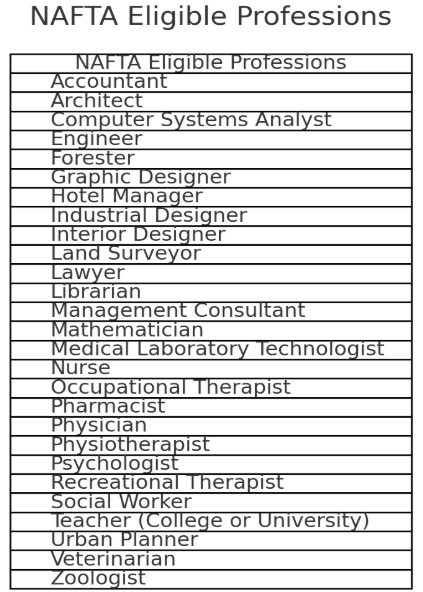
USMCA Professional List of Occupations
- Accountant
- Architect
- Computer Systems Analyst
- Disaster Relief Insurance Claims Adjuster
- Economist
- Engineer
- Forester
- Graphic Designer
- Hotel Manager
Requirements:
To qualify under the USMCA Professionals category, you must demonstrate that:
- You are a citizen of USA or Mexico (ex. passport, birth certificate)
- You have the abilities to work in your chosen professional field in Canada (ex. university degrees, professional certifications, professional licenses, certificate of qualification, employment reference letters)
- Valid job offer from a Canadian employer in one of the chosen USMCA professional occupations
USMCA Intra Company Transferee
Citizens of Mexico and USA who are working for an employer with locations in Canada may be eligible to transfer and work at the employer’s Canadian location for up to 3 years.
Requirements:
- You are a citizen of USA or Mexico
- Must have worked at least 1 year of full-time employment in the last 3 years before applying
- Confirmation of employment from employer in America or Mexico
- Proof of the relationship between the Canadian employer and the American or Mexican employer
- Your occupation in Canada must categorized as:
- Executive
- Managerial
- Specialized Knowledge
USMCA Investors
- You own or work for an American or Mexican company
- You intend or have committed to make a large capital investment in Canada
- If you are an employee, you must show proof of working in an (1) executive position, (2) managerial position or (3) a position which requires specialized skill
- NAFTA Investor work permits are valid for 1 year. You may extend this work permit for up to 2 years
USMCA Business Visitors
If you are an American or Mexican businessperson who needs to enter Canada to conduct short-term business, you may not require a work permit.
Program Details:
- Your sole intention is to enter Canada for short-term business
- Your income and primary place of business must be outside Canada
- Your business practice must be international in scope (not just focused on Canada)
- There is no evidence of you intending to enter the Canadian job market
How to Apply
You may only apply at a Canadian port of entry (POE). This means you will be evaluated at the port of entry and may not submit an application in advance.
Since you cannot submit a prior application, you must be prepared and armed with documents for examination at the Port of Entry.
USMCA Traders
- You are a trader whose job duties involves substantial trading in goods and services.
- The trading must primarily occur between Canada, USA and Mexico
- Your position must be (1) managerial, (2) executive or (3) specialized in nature
- USMCA Trader Work Permits are valid for 1 year. You may extend this work permit for up to 2 years.
Types of USMCA or NAFTA Work Permits in Canada
USMCA provides four primary categories for foreign workers seeking temporary work in Canada.
USMCA/NAFTA Professionals (Work Permit Code: T23)
This category is designed for skilled professionals from the United States and Mexico who work in one of 60+ eligible occupations and have a pre-arranged job offer in Canada.
Who Qualifies?
✔ You must be a citizen of the U.S. or Mexico
✔ You must be employed in one of the approved professional occupations
✔ You must have a job offer from a Canadian employer
✔ You must meet the qualifications and licensing requirements for your profession
Common Professions Under USMCA Professional Work Permits
- Engineers
- Accountants
- Architects
- Computer Systems Analysts
- Management Consultants
- Scientists (e.g., biologists, chemists, geologists)
How Long is the Work Permit Valid?
- Typically issued for up to three years, with renewals available.
- No maximum limit on the number of extensions, as long as the worker continues to meet eligibility criteria.
How to Apply
- At a Canadian Port of Entry (POE): U.S. and Mexican citizens can apply at the airport or border crossing for faster processing.
- Through IRCC: Applications can also be submitted online before traveling to Canada.
How to Qualify for a North American Free Trade Agreement (NAFTA) Work Permit: Your Guide to Fast-Track Employment in Canada
For professionals from the United States and Mexico, working in Canada has never been easier thanks to the United States-Mexico-Canada Agreement (USMCA), which replaced NAFTA. This agreement provides a streamlined work permit process for eligible professionals, allowing them to bypass the Labour Market Impact Assessment (LMIA) requirement and start working in Canada faster.
If you’re a highly skilled worker looking to take advantage of this opportunity, here’s everything you need to know about qualifying, applying, and securing your USMCA work permit.
Who is Eligible for a USMCA Work Permit?
To qualify for a USMCA Professional Work Permit, applicants must meet specific eligibility criteria to ensure they align with the agreement’s professional category requirements.
✔ Pre-Arranged Employment – You must have a valid job offer from a Canadian employer before applying. This means independent contractors or freelancers may not qualify unless they secure an official employment contract.
✔ Recognized Qualifications – Your education, certification, or professional experience must meet the standards for your listed occupation. Some fields may require a degree, licensing, or specialized training.
✔ Proof of Citizenship – You must hold a valid U.S. or Mexican passport to apply. Permanent residents of these countries are not eligible under this category.
How to Apply for a USMCA Work Permit
Applying for a USMCA work permit is much more straightforward than many other Canadian work permits, thanks to its exemption from the LMIA process. Here’s how to apply:
Step 1: Gather Your Supporting Documents
Ensure you have all necessary paperwork ready before submitting your application. This includes:
- A valid job offer from a Canadian employer detailing your role, duration, and salary.
- Educational and professional qualifications proving your eligibility for the job.
- A valid passport confirming your U.S. or Mexican citizenship.
- Any required licensing or accreditation (if applicable to your profession).
Step 2: Choose Your Application Method
- At a Canadian Port of Entry (POE): If you’re a U.S. or Mexican citizen, you can apply on arrival at a Canadian airport or land border. This allows for fast processing, and in many cases, applicants receive same-day approval.
- Through a Visa Office: If you prefer, you can submit your application online or through a Canadian visa office before traveling. This method allows for pre-approval before arriving in Canada.
Step 3: Receive Your Work Permit
If approved, you will be issued a work permit on the spot (for POE applications) or notified by IRCC if you applied online.
💡 Pro Tip: Double-check that your qualifications match the specific requirements of your profession under the USMCA agreement. Even a minor discrepancy can delay or result in a refusal of your application.
Why the USMCA NAFTA Professional Category Matters
Picture this: You’re a software engineer working in the U.S., and a Canadian company approaches you for a short-term contract to develop a cutting-edge AI system. Under a typical work permit process, your employer would have to go through the LMIA, proving that no Canadian could do the job. This process could take months, causing delays or even making the job opportunity unfeasible.
With a USMCA work permit, you skip the LMIA requirement entirely, meaning you can start working in Canada almost immediately.
This is a game-changer for professionals who need quick access to work in Canada without the hassle of prolonged government approvals.
Most In-Demand NAFTA Professional Occupations
If your job is on the USMCA list of approved professions, you may qualify for a work permit immediately. Here are some of the most common categories:
✔ Engineers – Civil, electrical, mechanical, and chemical engineers are frequently hired for cross-border infrastructure projects, environmental consulting, and energy sector developments.
✔ Accountants – Many U.S. and Mexican CPAs, auditors, and financial analysts support Canadian firms with tax filings, financial reporting, and compliance.
✔ Management Consultants – One of the most flexible categories, this role covers a wide range of industries, allowing professionals to provide business, finance, HR, and operational advice to Canadian companies.
✔ Computer Systems Analysts – With Canada’s booming tech industry, analysts frequently collaborate on software development, cybersecurity, and IT infrastructure projects.
💡 Pro Tip: If you work in an industry that isn’t traditionally listed, you might still qualify under the Management Consultant category, which applies broadly to various professions.
How We Help You Secure Your USMCA NAFTA Work Permit
Navigating immigration applications can be complicated, but our team specializes in simplifying the process. Whether it’s your first application or you’ve faced issues with a past submission, we can help you:
✔ Determine eligibility and ensure your job aligns with USMCA requirements.
✔ Prepare a strong application package with complete documentation.
✔ Avoid delays or refusals by making sure your qualifications match Canadian standards.
✔ Handle any complications related to licensing, employer requirements, or missing paperwork.
If you’re ready to start working in Canada without unnecessary obstacles, let us guide you through the fastest and most efficient route under the USMCA Work Permit program.

How USMCA Professionals in Engineering and Accounting Can Work in Canada
If you’re an engineer or accountant from the United States or Mexico, Canada offers exciting opportunities under the USMCA Professional Work Permit (formerly NAFTA). This streamlined work permit process removes the LMIA requirement, allowing skilled professionals to quickly secure employment in Canada without the usual bureaucratic red tape.
Here’s how engineers and accountants can qualify, what they contribute to Canadian businesses, and how to ensure a smooth application process.
1. Engineers (Civil, Electrical, Mechanical, Chemical & More)
Key Requirements for Engineering Professionals Seeking a Canadian Work Permit
If you’re an engineer looking to work in Canada under a USMCA/NAFTA work permit or another skilled worker pathway, you’ll need to meet specific eligibility criteria. Canadian employers and immigration authorities require strong educational qualifications, potential licensing, and pre-arranged employment to ensure you can integrate seamlessly into the workforce.
Let’s break down each requirement in detail so you understand what’s needed and how to prepare a strong application.
1. Educational Credentials: Do You Meet Canada’s Engineering Standards?
To qualify for an engineering role in Canada, you must hold a Bachelor’s degree or higher in a relevant engineering field.
✔ Degree Alignment – Your degree should be directly related to your area of expertise, such as:
- Civil Engineering – Infrastructure, construction, and urban development.
- Electrical Engineering – Power systems, telecommunications, automation.
- Mechanical Engineering – HVAC, machinery design, automotive technology.
- Chemical Engineering – Pharmaceuticals, manufacturing, environmental processes.
✔ Accreditation Matters – If your degree is from outside Canada, you may need an Educational Credential Assessment (ECA) from a recognized agency to confirm equivalency.
💡 Pro Tip: Having an accredited degree improves your eligibility for multiple immigration programs, such as Express Entry or the Provincial Nominee Program (PNP), if you choose to transition from a work permit to permanent residency.
2. Licensing (If Required): Are You Legally Allowed to Work as an Engineer in Canada?
While not all engineering roles require licensing, certain positions—especially those involving regulated engineering work, project sign-offs, or public safety oversight—require registration with a provincial engineering association.
✔ When Licensing is Required
- If you’re working in a professional engineering capacity and need to approve designs or oversee large-scale projects.
- If your employer or provincial regulations require it.
- If the job posting specifically mentions a requirement for Professional Engineer (P.Eng.) certification.
✔ How to Get Licensed in Canada
If your job requires licensing, you may need to register with one of the following regulatory bodies:
Provincial & Territorial Engineering Associations:
- Professional Engineers Ontario (PEO) – Covers Ontario-based engineering professionals.
- Engineers Canada – Oversees national licensure guidelines and professional accreditation.
- Other Provincial Engineering Regulators: Alberta (APEGA), British Columbia (EGBC), Quebec (OIQ), etc.
💡 Pro Tip: If you’re applying for a temporary work permit, you may not need full licensure immediately. However, having your application in progress can boost employer confidence and help with long-term career planning.
3. Pre-Arranged Employment: The Job Offer Requirement
Unlike some immigration pathways that allow self-application, most work permits require a confirmed job offer from a Canadian employer before applying.
✔ What Your Job Offer Must Include:
- A formal offer letter specifying your job title, responsibilities, and duration of employment.
- Salary details that meet industry standards and prevailing wages in Canada.
- Confirmation that the position aligns with your engineering field and qualifications.
✔ How to Secure a Job Offer Faster:
- Network with Canadian engineering firms through industry events and LinkedIn.
- Apply through engineering-specific job portals, such as:
- Engineers Canada Job Board
- Workopolis Engineering Careers
- Job Bank Canada (official government platform).
- Consider companies that frequently hire international engineers in sectors like infrastructure, energy, and manufacturing.
💡 Pro Tip: If your employer is unfamiliar with the work permit process, we can assist in guiding them through LMIA-exempt options (such as USMCA/NAFTA permits) to streamline the hiring process.
Next Steps: Get Ready for Your Canadian Engineering Career
✔ Ensure your degree meets Canadian standards (ECA if needed).
✔ Determine if you need licensing and start the application process early.
✔ Secure a strong job offer from a Canadian employer in your engineering field.
Need expert guidance? We specialize in work permit applications for engineers, licensing support, and job offer assistance—contact us today and let’s get you on the fastest path to working in Canada!
What Do Engineers Do in Canada?
USMCA permits open doors for engineers across various sectors. Common projects include:
- Civil Engineers – Work on infrastructure projects such as highways, bridges, water treatment plants, and urban development.
- Electrical Engineers – Design and implement power grids, renewable energy systems, and industrial automation.
- Mechanical Engineers – Focus on HVAC systems, robotics, automotive innovation, and advanced manufacturing.
- Chemical Engineers – Specialize in environmental sustainability, pharmaceuticals, and food processing industries.
With Canada’s booming infrastructure and energy sectors, engineers play a crucial role in keeping projects on track and introducing cutting-edge innovations.
How We Help Engineers Secure a USMCA Work Permit
✅ Credential Verification – We assess whether your degrees, certifications, and licensing meet Canadian requirements and help navigate any regulatory hurdles.
✅ Optimized Application Package – We ensure that your work permit application clearly aligns with Canadian job standards, increasing approval chances.
✅ Employer Support – We assist employers in drafting job offers that meet IRCC’s requirements, ensuring a smooth application process.
2. Accountants: Helping Canadian Businesses Stay on Track
✔ Educational Credentials – You must hold a Bachelor’s degree (or higher) in accounting or a related financial field.
✔ Certifications (If Required) – While a Certified Public Accountant (CPA) or equivalent credential is preferred, some employers accept international designations, especially if you have strong work experience.
✔ Familiarity with Canadian Accounting Standards – Canadian businesses often require knowledge of International Financial Reporting Standards (IFRS) or Canadian GAAP.
✔ Pre-Arranged Employment – Like all USMCA Professional Work Permits, you must have a job offer before applying.
What Do Accountants Do in Canada?
Accountants play a key role in Canadian businesses, ensuring financial stability, tax compliance, and regulatory accuracy. Common responsibilities include:
🔹 Financial Reporting – Preparing and analyzing financial statements for businesses, government agencies, and non-profits.
🔹 Tax Compliance – Assisting companies with corporate tax filings, audits, and regulatory requirements.
🔹 Budgeting & Forecasting – Helping businesses plan, allocate resources, and improve profitability.
🔹 Risk & Compliance Management – Ensuring adherence to Canadian financial regulations and preventing fraud.
With Canada’s strong financial sector, skilled accountants are always in demand, especially in industries like real estate, healthcare, and technology.
Why USMCA Work Permits Are a Game-Changer for Engineers & Accountants
Without USMCA, most foreign professionals must undergo the lengthy LMIA process, proving that no Canadian worker is available for the job. However, under USMCA Professional Work Permits, qualified engineers and accountants can bypass this requirement and start working in Canada faster.
If you’re ready to take your career to Canada without unnecessary delays, our team is here to make the process seamless and stress-free.
How We Help Accountants Secure a USMCA Work Permit
✅ Document Preparation – We assist in gathering proof of qualifications, including degrees, CPA certifications, and professional references.
✅ Work Permit Application Submission – We review and structure your submission to avoid errors or missing details that could delay approval.
✅ Employer Compliance Assistance – We help employers provide the correct job offer format required for fast-tracked work permits.
NAFTA Work Permits for Management Consultants & Computer Systems Analysts: How to Secure Your Spot in Canada
If you’re a Management Consultant or Computer Systems Analyst from the United States or Mexico, you could qualify for a USMCA Professional Work Permit—a fast-track route to working in Canada without the need for a Labour Market Impact Assessment (LMIA). These two job categories are among the most widely used and highly flexible under the agreement, making them an ideal pathway for professionals looking to establish themselves in Canada.
1. Management Consultants: The Most Flexible USMCA Work Permit Category
The Management Consultant category under USMCA (formerly NAFTA) is one of the most versatile and widely used work permit options for professionals. Unlike other categories that require specific degrees or industry certifications, this one focuses on your expertise, consulting experience, and ability to provide strategic advice.
✔ No rigid educational requirements – While a degree in business, finance, or a related field can strengthen your application, real-world experience matters more.
✔ Applies to multiple industries – Management consultants work across finance, IT, marketing, healthcare, supply chain, and other sectors.
✔ Ideal for independent contractors and corporate consultants – If you’re a freelancer or consultant working on short-term projects, this category could be your best fit.
Who Qualifies as a Management Consultant Under USMCA?
To be eligible for this work permit, you must:
✔ Have a documented history of consulting work, either as an independent consultant or as part of a firm.
✔ Showcase expertise in improving business efficiency, strategy, or operations within your industry.
✔ Provide proof of a Canadian job offer or consulting contract, outlining your role and expected contributions.
💡 Pro Tip: Even if your background is in a different field (e.g., finance, marketing, supply chain), you may still qualify if you can position yourself as a consultant providing expert advice to Canadian businesses.
What Do Management Consultants Do in Canada?
Management consultants help Canadian businesses optimize their strategies, streamline operations, and improve profitability. Some common consulting roles include:
🔹 Business Strategy & Operations Consulting – Helping businesses improve efficiency, reduce costs, and enhance overall operations.
🔹 Marketing & Sales Consulting – Providing market research, brand positioning, and digital marketing strategy development.
🔹 IT & Digital Transformation Consulting – Advising on software implementation, cybersecurity, and cloud computing solutions.
🔹 Supply Chain & Logistics Consulting – Helping companies improve sourcing, distribution, and inventory management.
Because this category covers so many industries, it is often used by professionals in various fields who provide advisory services to Canadian businesses.
How We Help You Secure a Management Consultant Work Permit
✅ Strategic Positioning – We assess your experience and frame your application to fit the consultant category, even if your background is in another profession.
✅ Gathering Documentation – We help compile case studies, consulting references, client contracts, and supporting documents to strengthen your case.
✅ Maximizing Approval Chances – Our team ensures your application aligns with IRCC’s expectations, reducing the risk of delays or refusals.
2. Computer Systems Analysts: The Fast-Track IT Work Permit
Why IT Professionals Are in High Demand in Canada
With Canada’s booming tech industry, Computer Systems Analysts are one of the most sought-after professionals under USMCA. If you’re an IT professional from the U.S. or Mexico, this work permit category can help you land jobs with top Canadian tech companies without the hassle of an LMIA.
✔ Opportunities in software development, cybersecurity, data analytics, and IT infrastructure.
✔ No LMIA required—skip the lengthy employer approval process.
✔ Fast-track entry to work on projects for Canadian tech firms, financial institutions, and government agencies.
Who Qualifies as a Computer Systems Analyst Under USMCA?
To be eligible for this work permit, you must:
✔ Hold a degree in computer science, information technology, or a related field.
✔ Have relevant certifications (e.g., Cisco, AWS, CompTIA, or cybersecurity credentials) that align with your job role.
✔ Secure a job offer from a Canadian employer in an IT-related field.
What Do Computer Systems Analysts Do in Canada?
This category covers a broad range of IT roles, including:
🔹 Software Development & Integration – Collaborating on new applications, cloud platforms, and AI-based solutions.
🔹 IT Infrastructure & Network Security – Designing and implementing enterprise-level IT networks and cybersecurity defenses.
🔹 Data Analytics & Business Intelligence – Helping businesses optimize data usage, improve reporting, and make strategic decisions.
🔹 Systems Optimization & Automation – Enhancing IT processes, streamlining workflows, and improving system efficiency.
Canada’s major cities—Toronto, Vancouver, and Montreal—are home to thriving tech ecosystems, making this an ideal opportunity for IT professionals.
How We Help You Secure a Computer Systems Analyst Work Permit
✅ Highlighting Your Technical Skills – We tailor your application to showcase your experience, certifications, and key competencies in software, networking, or cybersecurity.
✅ Aligning Your Application with Canadian IT Needs – We ensure that your work experience and qualifications match Canadian employer expectations.
✅ Expedited Processing – We navigate the process efficiently so you can start your job in Canada without unnecessary delays.

Why NAFTA Work Permits for Consultants & IT Professionals Are a Game-Changer
🔹 No LMIA required – Employers don’t have to prove they couldn’t find a Canadian worker for the job.
🔹 Faster processing times – Many USMCA work permits can be approved at the airport or border on arrival.
🔹 Flexible work arrangements – Consultants and IT professionals can work on short-term contracts or renewable permits.
How We Help You Get Your USMCA Work Permit—Stress-Free
Step 1: Professional Eligibility Assessment
Before we even begin the application, we conduct a detailed assessment of your background to determine which USMCA category best suits you. We evaluate:
- Your educational credentials (degrees, diplomas, and certifications).
- Your work experience and how it aligns with approved USMCA professions.
- Licensing or accreditation requirements for specific fields (e.g., engineers, accountants).
If your job title doesn’t neatly fit into a listed USMCA category, we explore ways to position your expertise under an eligible role (e.g., Management Consultant for business professionals).
Step 2: Comprehensive Document Preparation
A strong application starts with strong documentation—and we make sure yours is flawless.
We help you gather and organize:
✔ Proof of citizenship (valid U.S. or Mexican passport).
✔ Academic transcripts and degree certificates, ensuring they meet Canadian equivalency.
✔ Professional certifications or licenses, if required for your role.
✔ A properly structured job offer from your Canadian employer, detailing your responsibilities and salary.
✔ Supporting letters or case studies for consultants, if applying under the flexible Management Consultant category.
One missing document can cause delays or rejections, so we leave no room for error.
Step 3: Employer Support & Compliance
Many Canadian employers aren’t familiar with the USMCA work permit process—and this can lead to delays or misunderstandings.
We work directly with your employer to:
- Ensure your job offer meets IRCC standards and includes all required details.
- Explain the employer’s role in the application process to avoid mistakes.
- Clarify common concerns, such as tax obligations, payroll setup, and work permit renewals.
With our guidance, your employer feels confident in hiring you, and you get approved faster.
How to Apply for a USMCA Professional Work Permit
Applying for a USMCA work permit is significantly faster than traditional work permits, thanks to its LMIA exemption. Here’s a step-by-step breakdown of how to apply:
Step 1: Secure a Job Offer in Canada
Your employer must provide a formal job offer, outlining your position, responsibilities, and salary. The offer should clearly show that the job falls within an approved USMCA profession.
Step 2: Gather Your Documents
In addition to proof of citizenship and educational qualifications, some applicants may need to provide:
- Professional certifications or industry licenses.
- Employer letters verifying past experience.
- A detailed contract or engagement letter (especially for consultants).
Step 3: Submit Your Application
🔹 For U.S. citizens – You can apply directly at a Canadian airport, land border, or pre-clearance facility, receiving same-day processing.
🔹 For Mexican citizens – You will typically need to apply through a visa office before traveling to Canada.
Step 4: Pay the Application Fee
The standard fee is CAD $155, though this may vary depending on additional work permit conditions (e.g., extending a permit).
💡 Pro Tip: Applying at a port of entry (POE), such as an airport, often results in faster approval, especially for U.S. applicants.
Why a USMCA Work Permit is a Game-Changer for Professionals
🔹 Skip the LMIA Hassle – Unlike most work permits, USMCA professionals don’t require a Labour Market Impact Assessment (LMIA), making the process quicker and easier for both you and your employer.
🔹 Faster Entry into Canada – Most USMCA professionals get approved at the airport or border crossing, allowing for same-day processing in many cases.
🔹 Multiple-Entry Work Permits – Your work permit can be issued for up to three years, with unlimited renewals as long as you remain eligible.
🔹 Opportunities Across Industries – From tech and finance to engineering and healthcare, the USMCA work permit covers a wide range of professions that are in high demand in Canada.
Real-Life Success: How USMCA Helped Maria Start Her Career in Canada
🔹 Maria, a biologist from Mexico, landed a two-year contract with a Canadian environmental research lab. Under normal circumstances, the employer would have needed to apply for an LMIA—a process that could take months.
🔹 Because Maria’s profession was on the USMCA list, she bypassed the LMIA process and applied directly at a visa office.
🔹 Within weeks, she was in Canada, contributing to groundbreaking environmental studies—without the usual work permit delays.
For thousands of professionals like Maria, the USMCA work permit is a career-changing opportunity.
Let’s Get Your Work Permit Approved—Quickly & Hassle-Free
If you’re ready to work in Canada under the USMCA Professional Work Permit, we’re here to help. Our team ensures that your application is complete, your documents are in order, and your employer understands their role—so you get approved fast.
📞 Contact us today to start your application and take the next step in your career!

NAFTA Intra-Company Transferees (ICT): A Fast-Track Work Permit for Global Talent
Imagine working for a multinational company and being offered the exciting opportunity to transfer to your company’s Canadian office. Whether you’re a senior executive, a project manager, or a specialist with deep expertise in your field, the USMCA Intra-Company Transferee (ICT) work permit makes it possible to relocate to Canada seamlessly—without the need for a Labour Market Impact Assessment (LMIA).
This category is designed to streamline business expansion, foster knowledge sharing, and facilitate international mobility for key employees. If you’re being transferred to a Canadian branch, affiliate, or subsidiary, here’s what you need to know about eligibility, benefits, and how to apply.
Who Qualifies for an Intra-Company Transfer Under USMCA/NAFTA?
To qualify as an Intra-Company Transferee (ICT) under the USMCA (formerly NAFTA), you must meet these key requirements:
✔ Minimum One Year of Employment – You must have worked for your company continuously for at least one year within the last three years before applying.
✔ Position in Canada Must Be Either Managerial or Specialized – Your role in Canada should fall under one of these two categories:
- Senior Manager/Executive: Overseeing teams, departments, or critical company functions.
- Specialized Knowledge Worker: Possessing deep expertise in proprietary software, unique technologies, or industry-specific processes that are critical to the company’s success.
✔ Relationship Between Companies Must Be Proven – The Canadian office must be a parent company, subsidiary, branch, or affiliate of your current employer. Your employer must provide documents such as:
- Corporate structure charts showing company relationships.
- Business registration papers from both the Canadian and foreign entities.
- Organizational documents demonstrating the business connection.
Why Choose the USMCA ICT Work Permit?
The Intra-Company Transferee work permit is one of the fastest and most employer-friendly ways for international professionals to work in Canada. Here’s why:
✅ No LMIA Required – Unlike most work permits, companies do not need to prove they couldn’t find a Canadian worker for the job. This eliminates delays and red tape, making it easier for businesses to transfer talent.
✅ Quick Processing Times – Applications are often processed in a matter of weeks, allowing professionals to transition smoothly into their new roles.
✅ Valid for Up to 3 Years, with Renewals Available – The ICT permit is initially issued for one to three years and can be renewed for up to seven years for senior executives and five years for specialized knowledge workers.
✅ Pathway to Permanent Residency – Intra-company transferees often qualify for Express Entry under the Canadian Experience Class (CEC) or Provincial Nominee Programs (PNPs), making it easier to transition to permanent residency.
✅ Family Benefits – Your spouse is eligible for an open work permit, and children can study in Canada while you work.
Real-Life Example: How Raj Secured His Intra-Company Transfer to Canada
Raj, a software architect from the United States, had been working with a multinational tech firm for five years when the company’s Toronto office approached him with an opportunity to lead a high-priority project. His expertise in proprietary cloud computing systems made him the perfect candidate to drive innovation in the Canadian branch.
With our guidance, Raj’s application included:
- Proof of employment history and qualifications.
- A clear job description outlining his role in Canada.
- Corporate documentation confirming the connection between the U.S. and Canadian offices.
💡 The result? Within just a few weeks, Raj’s ICT work permit was approved, and he was leading a groundbreaking AI project in Canada.
How to Apply for an Intra-Company Transferee (ICT) Work Permit
Applying for an Intra-Company Transferee work permit requires careful documentation and a well-structured application. Here’s the step-by-step process:
Step 1: Gather Required Documents
Your employer must provide a detailed job offer letter explaining your role in Canada, along with:
- Proof of employment history (confirming at least one year of work with the company in the past three years).
- Corporate documents showing the connection between the foreign and Canadian offices.
- Detailed job description explaining your managerial or specialized knowledge role.
Step 2: Submit the Application
You can apply:
- At a Canadian Port of Entry (POE): U.S. citizens can apply at the airport or border, often receiving same-day approvals.
- Online or through a Visa Office: Mexican citizens typically need to apply through a visa processing center before traveling.
Step 3: Pay the Application Fee
- Standard work permit processing fee: CAD $155
- If applying with dependents, additional fees may apply for spouse open work permits and study permits for children.
Step 4: Receive Your Work Permit & Start Your Role in Canada
Once approved, you’ll receive a work permit valid for up to three years, allowing you to begin your new position in Canada immediately.
💡 Pro Tip: Ensuring that your job description and supporting documents clearly demonstrate the need for a managerial or specialized role is critical for approval.
How We Help You Secure Your ICT Work Permit—Stress-Free
Navigating work permit applications can be challenging, especially when multiple company entities are involved. That’s why we offer expert guidance to make the process smooth and hassle-free.
✔ Full Eligibility Assessment – We evaluate your role, company structure, and qualifications to ensure you meet all ICT requirements.
✔ Flawless Documentation Support – From corporate paperwork to job descriptions, we ensure every document is properly prepared.
✔ Application Strategy & Submission – We guide both you and your employer through the process, avoiding common pitfalls and delays.
✔ Faster Processing, Fewer Rejections – Our expertise in framing strong applications helps ensure approvals without unnecessary complications.
Is an Intra-Company Transfer Right for You? Let’s Make It Happen!
For global professionals working in multinational companies, Canada’s Intra-Company Transfer (ICT) work permit offers a streamlined pathway to temporarily work in Canada without the hassle of a Labour Market Impact Assessment (LMIA).
Whether you’re coming from the United States, Mexico (under USMCA), India, the UK, or any other country, the ICT category allows employees to relocate to a Canadian branch, subsidiary, or affiliate of their company—facilitating global business expansion and talent mobility.
If you’re an executive, senior manager, or specialized knowledge worker, here’s everything you need to know about qualifying, applying, and maximizing your chances of approval.

Who Qualifies for an Intra-Company Transfer (ICT) Work Permit?
To be eligible for an ICT work permit, you must meet three key requirements:
1. Continuous Employment with Your Company
- You must have been employed full-time for at least one year within the last three years at your current company.
- Your role must be in a qualifying position (executive, senior manager, or specialized knowledge worker).
2. The Canadian & Foreign Offices Must Be Connected
- The company you currently work for must have a qualifying business relationship with the Canadian entity, such as:
✔ A parent company
✔ A subsidiary
✔ A branch office
✔ An affiliate - The employer must provide documentation proving this connection, such as:
✔ Business registration documents
✔ Organizational charts showing company structure
✔ Financial reports or tax filings demonstrating business activity
3. Your Role in Canada Must Be a Senior or Specialized Position
Your position in Canada must fall under one of these three categories:
🔹 Senior Managers: Responsible for overseeing teams, departments, or entire business operations. Example: A Regional Director overseeing a division across North America.
🔹 Executives: Holding decision-making authority over company policies, strategies, and operations. Example: A Chief Technology Officer (CTO) launching new digital initiatives.
🔹 Specialized Knowledge Workers: Possessing advanced expertise about the company’s services, technology, or proprietary systems. Example: A Cloud Engineer transferring to Canada to implement a custom software solution.
💡 Pro Tip: Specialized knowledge workers must prove that their expertise is unique to the company and cannot easily be found in Canada.
Why Choose an ICT Work Permit?
Unlike standard work permits that require an LMIA (proving no Canadian can do the job), the Intra-Company Transfer work permit makes it faster and easier to bring key employees to Canada.
Top Benefits of the ICT Work Permit
✔ NO LMIA Required – Employers don’t need to prove there’s a labor shortage, saving time and paperwork.
✔ Fast Processing – Work permits are processed in as little as 2 to 12 weeks depending on the visa office.
✔ Valid for Up to 3 Years – ICT work permits can be issued for 1-3 years initially, with renewals available for up to 7 years for executives & 5 years for specialized workers.
✔ Pathway to Permanent Residency – ICT workers often qualify for Express Entry under the Canadian Experience Class (CEC) or Provincial Nominee Programs (PNPs), making PR easier.
✔ Family Benefits – Your spouse is eligible for an open work permit, and children can study in Canada while you work.
💡 Bonus: If your company is expanding into Canada, an ICT work permit can be used to establish a new Canadian branch—allowing key personnel to relocate temporarily while setting up operations.
How to Apply for an ICT Work Permit (Step-by-Step Guide)
Step 1: Prove the Relationship Between Entities
Your employer must submit clear documentation proving that the Canadian company is linked to the foreign entity. Required documents may include:
✔ Business registration documents (both foreign and Canadian)
✔ Organizational charts showing ownership structure
✔ Tax filings or financial reports
✔ Corporate records demonstrating shared management or operations
Step 2: Prepare Supporting Documents
You’ll need to submit:
✔ Proof of Employment History – Pay stubs, tax returns, and an employment verification letter confirming your tenure.
✔ Detailed Job Description – Clearly outlining your role, responsibilities, and how they align with ICT requirements.
✔ Business Plan (if applicable) – If the Canadian entity is new, a detailed business plan must demonstrate its long-term viability.
Step 3: Submit the Work Permit Application
You can apply:
- Online via the IRCC Portal
- At a Visa Office (for non-US citizens)
- At a Canadian Port of Entry (for U.S. citizens applying directly at the border)
💰 Fees:
✔ Work Permit Fee: CAD $155
✔ Employer Compliance Fee: CAD $230
Step 4: Employer Compliance Filing
The Canadian employer must submit an Offer of Employment through the Employer Portal, outlining:
✔ Salary and job details
✔ Justification for the transfer
✔ How the transfer will benefit Canada
Step 5: Wait for Processing & Receive Your Work Permit
- Processing times vary (2 to 12 weeks) depending on the visa office handling the application.
- If approved, you’ll receive a work permit valid for up to 3 years.
💡 Pro Tip: If applying at a Port of Entry (POE), such as an airport or border crossing, U.S. citizens can often get same-day approval.
ICT Work Permits for Non-USMCA Countries (e.g., India, UK, Europe, etc.)
The Intra-Company Transfer program is NOT exclusive to USMCA countries (U.S. & Mexico). Employees from India, China, Europe, and other non-USMCA countries can still apply under Canada’s International Mobility Program (IMP).
🌍 Key Requirements for Non-USMCA ICT Applicants:
✔ One year of continuous employment within the past three years.
✔ Proof of business relationship between the foreign and Canadian entities.
✔ Senior or specialized role that benefits Canada.
💡 Pro Tip: Indian IT professionals frequently use the ICT work permit to transfer to Canada’s booming tech sector.
Why Work With Us? Your Trusted Partner for ICT Work Permits
We specialize in fast-tracking ICT work permit applications and ensuring your company’s global mobility strategy is executed seamlessly.
💼 Here’s How We Help:
✔ Strategic Eligibility Assessment – We determine the strongest way to position your application for approval.
✔ Flawless Documentation Preparation – We help compile proof of employment, company relationships, and job duties.
✔ Employer Compliance Support – We guide your Canadian employer through the filing process, ensuring IRCC requirements are met.
✔ Faster Approvals & Fewer Delays – Our tailored approach ensures your application is strong from day one.
What is the USMCA Trader (T21) Category?
The USMCA Trader category is designed for individuals and companies that engage in substantial trade between Canada and either the United States or Mexico. Unlike traditional business visitor visas, this category offers a structured work permit that allows you to live and operate in Canada legally while facilitating trade transactions.
Key Highlights:
✔ Trade isn’t limited to physical goods—services, consulting, and technology-driven transactions also qualify.
✔ No LMIA required—making it easier and faster for businesses to expand across borders.
✔ The business must be based in the United States or Mexico, with more than 50% of its trade volume occurring with Canada.
✔ Applicants must hold an executive, managerial, or supervisory role within the company.
If you or your company meet these conditions, you can quickly obtain work authorization in Canada to manage and grow your trade operations.
Who Qualifies for the USMCA Trader Work Permit?
To be eligible for this work permit, you must meet the following key requirements:
- Substantial Trade Requirement
- At least 50% of your company’s total trade must be between Canada and your home country (U.S. or Mexico).
- Trade can include:
✔ Physical goods (e.g., manufacturing, consumer products, raw materials).
✔ Services (e.g., IT consulting, financial services, legal support, logistics).
✔ Technology & intellectual property (e.g., software development, cloud services).
💡 Pro Tip: If your company primarily sells services (rather than goods), be prepared to provide client contracts, service agreements, and transaction records that show a direct relationship with Canadian partners.
- You Must Hold an Executive or Supervisory Role
- You must be in a leadership position within the company, such as:
✔ Business Owner or CEO – Overseeing operations and high-level decision-making.
✔ Sales Director or Trade Manager – Responsible for negotiating trade deals and overseeing cross-border transactions.
✔ Senior Operations Manager – Ensuring the execution and delivery of goods/services to Canadian clients.
Why? The goal of this work permit is to bring key business leaders who drive trade, not general employees or administrative staff.
- Proof of Trade Between Your Company and Canada
You must provide concrete documentation proving that your company actively trades with Canada and meets the 50% trade threshold. Required documents may include:
✔ Invoices and purchase orders showing exports/imports with Canadian partners.
✔ Contracts or long-term agreements with Canadian businesses.
✔ Shipping records and customs documentation for physical goods.
✔ Financial reports proving your company’s revenue streams.
💡 Pro Tip: A business plan detailing future trade expansion can strengthen your case, especially if your company is in the early stages of growth in Canada.
Why Choose the USMCA Trader Work Permit?
Unlike other business immigration programs that require an LMIA or extensive employer approvals, the USMCA Trader work permit provides a streamlined, business-friendly solution to conducting trade in Canada.
🔥 Top Benefits of the USMCA Trader Category
✔ Fast & Simplified Market Entry – No LMIA means fewer delays and faster approvals, allowing you to immediately start operations in Canada.
✔ Long-Term Growth Potential – Work permits are issued for up to one year initially, with renewals available as long as trade continues.
✔ Enhanced Business Credibility – Being recognized under the USMCA Trader category signals to Canadian partners and clients that your business is established and meets international trade standards.
✔ Cross-Border Trade Made Easy – Facilitates seamless transactions, deal-making, and logistics management without restrictions placed on general work permits.
✔ No Investment Requirement – Unlike some business immigration programs, you don’t need to invest a specific amount to qualify.
Real-Life Example: How the USMCA Trader Category Helped David Expand His U.S. Business to Canada
David owns a Texas-based manufacturing company that exports high-quality industrial equipment to clients across North America. As Canada became his largest market, he needed to establish a permanent presence in Toronto to manage logistics, expand his customer base, and negotiate new trade deals.
With our help, David:
✔ Provided trade invoices proving that over 60% of his company’s revenue came from Canadian clients.
✔ Submitted service contracts demonstrating the long-term nature of his business relationships in Canada.
✔ Structured his application as an executive overseeing Canadian operations, meeting the managerial role requirement.
💡 The result? David received a one-year renewable USMCA Trader work permit, allowing him to operate in Canada without the need for an LMIA—giving him the flexibility to scale his business further.
How to Apply for a USMCA Trader Work Permit (Step-by-Step Guide)
✅ Step 1: Gather Required Documents
✔ Proof of substantial trade (50%+ of transactions with Canada).
✔ Company registration and tax documents.
✔ Job title and proof of executive/supervisory role.
✔ Detailed description of trade activities in Canada.
✅ Step 2: Submit Your Application
- U.S. citizens can apply directly at the airport or land border for same-day processing.
- Mexican citizens must apply through a visa office before entering Canada.
💰 Application Fees:
✔ Work Permit Fee: CAD $155
✔ Employer Compliance Fee (if applicable): CAD $230
✅ Step 3: Start Trading in Canada!
Once approved, you’ll receive a one-year work permit, which can be renewed indefinitely as long as your company maintains its trade relationship with Canada.

How to Apply for a USMCA Trader Work Permit (T21)
The application process requires strong documentation to prove your trade activities and your executive role within the company. Below is a detailed step-by-step guide to ensure a smooth and successful application.
Step 1: Develop a Strong Business Plan
Your business plan is the foundation of your application. It must clearly outline:
✔ Nature of your trade activities – What goods, services, or technology do you trade with Canada?
✔ Current and future trade volume – Demonstrate that at least 50% of your company’s trade is with Canadian clients.
✔ Key Canadian partners or customers – Provide proof of ongoing business relationships in Canada.
✔ Growth strategy – Show how your presence in Canada will expand trade opportunities.
💡 Pro Tip: Including market research on Canada’s demand for your products or services strengthens your case and proves economic benefit.
Step 2: Gather All Supporting Documents
To prove the legitimacy of your trade relationship, you must submit concrete evidence of transactions between your company and Canadian clients. Required documents include:
✔ Financial Statements – Demonstrating the company’s revenue streams and business stability.
✔ Contracts & Agreements – With Canadian buyers, suppliers, or business partners proving active trade relationships.
✔ Invoices & Purchase Orders – Showcasing the volume and frequency of transactions with Canadian businesses.
✔ Shipping Records & Customs Documentation – If trading physical goods, proof of regular imports/exports to and from Canada.
✔ Company Registration Documents – Business licenses, tax filings, and incorporation records to prove your company’s legitimacy.
💡 Pro Tip: For service-based businesses, client service agreements, signed consulting contracts, and payment records are key to demonstrating trade volume.
Step 3: Submit Your Application
Your application can be submitted:
✔ At a Canadian Port of Entry (POE) – Fastest option for U.S. citizens, allowing for same-day processing at the airport or border crossing.
✔ Online via the IRCC Portal – For those who prefer digital submission and tracking.
✔ Through a Visa Office – Required for Mexican applicants or those applying from outside North America.
💰 Application Fees:
- Work Permit Fee: CAD $155
- Employer Compliance Fee (if applicable): CAD $230
💡 Pro Tip: U.S. applicants applying at the border should bring all original documents for instant processing.
Step 4: Follow-Up & Decision Process
Once submitted, IRCC may request additional information or schedule an interview to verify details.
✔ If approved, you’ll receive a USMCA Trader work permit valid for up to one year, with renewals available as long as trade continues.
✔ If further documentation is needed, we help you prepare additional evidence and respond to IRCC requests quickly.

Why Work With Us?
Navigating the USMCA Investor and Trader work permit process can be overwhelming—but you don’t have to do it alone.
What We Offer:
✔ Expert Guidance – We help identify the best work permit option for your business.
✔ Flawless Documentation Review – Ensure all documents meet Canadian immigration standards.
✔ Seamless Application Handling – We submit and track your application, so you don’t have to worry about delays or mistakes.
💡 Pro Tip: A well-prepared application has a significantly higher chance of approval—let us handle the details so you can focus on growing your business.
📞 Ready to take your business to Canada? Contact us today for a consultation!
Final Thoughts: Your Future in Canada Starts Now
Whether you’re a U.S. investor expanding your company (T22) or a global entrepreneur bringing innovation to Canada (C11), there’s a pathway for you.
📌 Don’t leave your future to chance. With the right strategy and expert support, you can secure your business work permit, establish a thriving company in Canada, and unlock new opportunities.
📞 Let’s make it happen—Contact us today to get started!

Ready to Get Approved? Let’s Talk.
How We Can Help
Applying for work permits can be a tedious and often confusing process with all the requirements, fees, and steps to be taken.
The USMCA was designed to break down barriers in economic immigration and cross-border movement of labour. To that end, if you wish to benefit from the provisions of these agreements, you will need to prepare. It is not just about obtaining the required documentation and submitting your application. To ensure you have the highest chances of success, you must go above and beyond minimum requirements.
At VisaPath, our representatives are highly trained and experienced with USMCA work permits applications, guiding you through each step of the process to give you the best possible chances of success.
If you are ready to get started or would like to know more, please contact VisaPath at 416-477-2570.

Frequently Asked Questions
What does USMCA stand for?
This acronym stands for United States of America (U.S.), Mexico and Canada Agreement. It is a trade agreement between the three countries. This new agreement was implemented to replace the North America Free Trade Agreement (NAFTA).
This trade agreement will maintain key elements of the trading relationship and implement a new provision that addresses trade issues and created opportunities. The purpose of this new trade agreement is for economic growth and help raise the living standard for everyone who is a member of the three parties involved.
If you are from Canada than you can refer to this agreement as Canada – United States – Mexico Agreement (CUSMA), if you are from Mexico than you will refer to this agreement as Mexico, Estados Unidos y Canada (T-Mec).
When will the USMCA agreement be implemented?
The trade agreement was officially implemented on July 1, 2020. The new trade agreement will help strengthen the rules and regulations that each country must abide by, give clearer and concise procedural guidelines for trade and investment, and build a solid foundation for Canada’s trade liberalization.
What are the key changes from NAFTA to CUSMA (USMCA)?
The new trade agreement directly imposes the key changes of the following issues:
- Proof of origin procedures
- Refunds
- Importing goods
- Textile and apparel
- Tariff treatments
- Taxes
- Incentives and remedies