
C11 Work Permits
Are you a business owner looking to establish your business in Canada and gain Canadian work experience? We can help you achieve your goal
What is the C11 Work Permit?
Imagine this: you’re an entrepreneur or self-employed professional eager to establish a business in Canada or share your exceptional talents in the Canadian market. The C11 Work Permit could be your gateway! This program allows foreign nationals to secure a work permit without requiring a Labour Market Impact Assessment (LMIA). It’s specifically designed for individuals who:
- Have significant control over their work.
- Offer contributions that enhance Canada’s economic, cultural, or social landscape.
Let’s explore how the C11 program can help you turn your dreams of living and working in Canada into a reality.
Why is the C11 Work Permit Unique?
Unlike traditional work permits tied to an LMIA—a process where employers must prove no Canadians are available to fill the role—the C11 bypasses this step. Why? Because it’s built for innovators, creators, and entrepreneurs who go beyond simply filling a job. It’s a program that values those who generate opportunities, foster innovation, and contribute meaningfully to Canadian society.
Who is Eligible?
The C11 Work Permit is designed for individuals meeting specific criteria. Here’s who can apply:
Entrepreneurs
Do you have a bold vision for starting or expanding a business in Canada? The C11 Work Permit is ideal for entrepreneurs who have substantial control over their operations and aim to create businesses that contribute to Canada’s economy. This includes generating jobs for Canadians, driving local growth, or fostering innovation. Whether you’re launching a tech start-up, opening a boutique hotel, or introducing a unique design firm, your entrepreneurial spirit is valued here.
Self-Employed Professionals
Are you a consultant, freelancer, artist, or IT specialist working independently? The C11 Work Permit recognizes the unique value self-employed professionals bring. It’s perfect for individuals whose work enhances Canada’s cultural, economic, or social framework without being tied to one employer. For example:
- A digital consultant optimizing Canadian businesses.
- An artist enriching Canada’s cultural scene.
Your application must show how your skills or work positively impact Canadian society
Visionaries Driving Impact
The C11 program also caters to individuals with innovative ideas or specialized skills that address gaps in the Canadian market. Whether you’re developing eco-friendly solutions, introducing healthcare innovations, or advancing cutting-edge technologies, this pathway values originality and the ability to drive meaningful change.
Take the Next Step
The C11 Work Permit isn’t just about moving to Canada—it’s about creating something impactful. Whether you’re an entrepreneur, self-employed professional, or a visionary with a bold idea, this program offers you a platform to shine while contributing to Canada’s growth.Are you ready to start your journey? Canada is ready to welcome your talent, innovation, and entrepreneurial drive.
Key Features of the C11 Work Permit
No LMIA Requirement
One of the most significant advantages of the C11 Work Permit is that it eliminates the need for a Labour Market Impact Assessment (LMIA). Traditional work permits require employers to prove that no Canadian citizen or permanent resident is available to fill a specific role—a process that can be both time-consuming and restrictive. The C11 program, however, focuses on applicants who bring unique, irreplaceable value to Canada. Whether it’s a specialized skill, an innovative business idea, or a cultural contribution, the emphasis is on how you can enhance Canada’s economic and social landscape.
Why This Matters:
- Saves Time: By bypassing the LMIA process, you avoid unnecessary delays and paperwork.
- Recognizes Your Value: Your unique contributions are acknowledged without requiring labor market justification.
Example:
Imagine you’re an entrepreneur with a groundbreaking app idea tailored for the Canadian market. Instead of navigating the lengthy LMIA process, the C11 Work Permit allows you to focus directly on launching and growing your business in Canada.
A Pathway to Permanent Residency (PR)
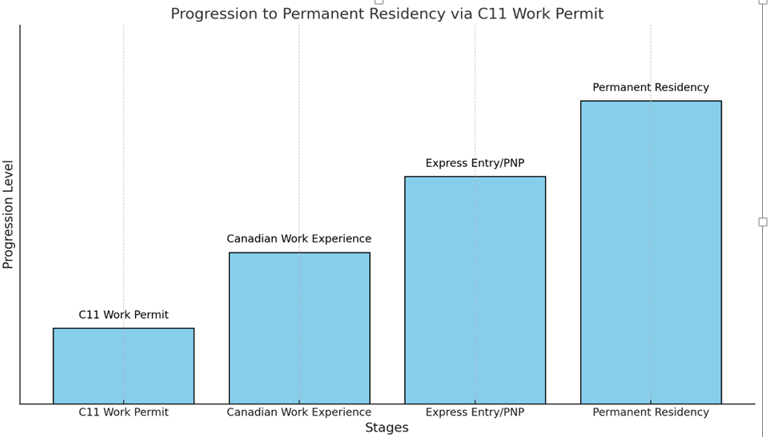
Although the C11 Work Permit is a temporary authorization, it often serves as a stepping stone toward permanent residency (PR) in Canada. Many successful C11 applicants transition to PR through options like Express Entry (via the Canadian Experience Class or Federal Skilled Worker Program) or Provincial Nominee Programs (PNPs) designed for entrepreneurs and innovators. For those with long-term plans, the C11 is an excellent starting point.
How It Works:
- Gain Canadian Experience: Build work experience in Canada, which can improve your Comprehensive Ranking System (CRS) score for Express Entry.
- Leverage PNP Opportunities: Many provinces prioritize entrepreneurs and innovators in their PNPs, offering an expedited pathway to PR.
Next Steps:
The C11 Work Permit is more than a temporary work opportunity—it’s your gateway to living, working, and thriving in Canada. Keep reading to learn how you can transition your C11 Work Permit into a permanent residency application.
Example of Success with the C11 Work Permit
Imagine you’re an independent software developer who secures a C11 permit to launch a start-up in Canada. Over two years, your business flourishes, creating jobs and contributing to the local economy. With this success, you apply for permanent residency through a Provincial Nominee Program (PNP) specifically designed for entrepreneurs.
Flexibility in Operations
Unlike traditional work permits that tie you to a single employer, the C11 Work Permit allows you to work independently and take control of your professional journey. Whether you’re running a business, managing clients, or pursuing innovative ventures, the C11 gives you the freedom to align your work with your vision.
Advantages of Flexibility:
- Autonomy: You determine your hours, projects, and strategic decisions.
- Scalability: You can grow your business without the restrictions of employer-based permits.
- Adaptability: Adjust your business model or offerings to meet market demands.
Example:
An artist on a C11 permit might open a gallery to showcase their work while simultaneously taking on freelance commissions. This flexibility allows them to diversify their income and expand their artistic reach.
Empowering Diverse Career Paths
The C11 Work Permit is uniquely designed to accommodate a wide range of professionals, from entrepreneurs and freelancers to innovators. It ensures you have the freedom to navigate your career path on your own terms, without being tethered to a single employer or rigid framework.
- Autonomy in Decision-Making: You control your schedule, clients, and business direction.
- Freedom to Scale: Whether you want to expand your team, open additional locations, or increase your services, the C11 removes bureaucratic barriers to growth.
- Room to Adapt: The C11 recognizes that the market evolves, and your business can too.
Scalability in Action:
Take the example of Sara, a designer who started her boutique agency in Toronto. With the flexibility of her C11 Work Permit, she expanded nationwide, attracted high-profile clients, and grew her portfolio. This success fast-tracked her path to permanent residency within a few years.
Adaptability at Its Core:
The C11 Work Permit enables you to pivot when necessary, ensuring you remain relevant in a dynamic market. For instance, a self-employed chef may begin with plans to open a restaurant but later shift focus to meal-prep services after recognizing a higher demand. The C11 allows for such transitions without imposing limitations, supporting your success in any venture.
With the C11 Work Permit, you’re not just working in Canada—you’re building, growing, and innovating on your terms. This program empowers you to make meaningful contributions while creating a future that aligns with your ambitions.
The Importance of Flexibility
Flexibility isn’t just a perk—it’s a powerful advantage. For entrepreneurs and independent professionals, it provides the freedom to:
- Seize Opportunities: Diversify your income by working with multiple clients or launching complementary ventures.
- Foster Innovation: Dedicate resources and energy to creative, high-risk, high-reward projects without worrying about losing your work authorization.
- Adapt to Change: Stay agile in a dynamic environment by responding quickly to economic, social, or technological shifts, ensuring your business stays relevant and successful.
The C11 Work Permit is more than just permission to work—it’s a springboard for entrepreneurial freedom. It empowers you to pursue opportunities, scale your ambitions, and create a prosperous future in Canada.
Who Benefits from the C11 Work Permit?
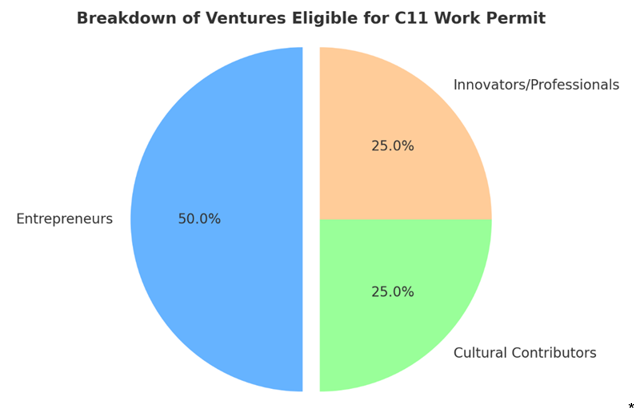
Entrepreneurs
Whether you’re in tech, hospitality, or any other field, if your business brings economic value, the C11 supports your vision.
Cultural Contributors
Artists, filmmakers, and performers who enrich Canada’s vibrant cultural landscape.
Innovators
Professionals who introduce groundbreaking solutions that elevate Canadian industries.
The C11 Work Permit: A Gateway to Opportunity in Canada
The C11 Work Permit opens doors for entrepreneurs, self-employed professionals, and visionaries. With its LMIA exemption, unmatched flexibility, and potential as a pathway to permanent residency, it’s more than just a work permit—it’s a launchpad for a rewarding life and career in Canada. Whether your goal is to build a business, innovate in your field, or enrich Canada’s cultural landscape, the C11 program provides the tools to make it happen
Why Canada Embraces the C11 Work Permit
The Canadian government designed the C11 program to attract global talent, foster innovation, and strengthen the economy. By welcoming entrepreneurs and self-employed professionals, Canada secures its competitive edge on the world stage. The benefits extend beyond economic growth:
- Cultural Enrichment: Artists, writers, and performers bring fresh global perspectives to Canada’s diverse cultural fabric.
- Job Creation: Entrepreneurs establish businesses that employ Canadians and stimulate local economies.
- Social Contributions: Self-employed professionals fill service gaps, improving community quality of life.
Cultural Enrichment: A Symphony of Global Influence
Through the C11 Work Permit, artists, writers, and performers infuse Canada’s cultural landscape with rich global perspectives. Imagine a renowned painter introducing innovative techniques in Canadian galleries or a celebrated novelist drawing inspiration from international experiences to craft a bestseller. These contributions enhance Canada’s artistic tapestry by hosting exhibitions, workshops, and performances that inspire and engage communities nationwide.
By fostering cultural exchange, these professionals expand Canada’s creative horizons. For example, an international choreographer might establish a dance academy to train Canadian youth, enriching lives and enhancing Canada’s reputation for cultural excellence.
Job Creation: Fueling Local Economies, One Business at a Time
Entrepreneurs leveraging the C11 Work Permit not only realize their own dreams but also drive local economic growth. By establishing businesses, they create jobs for Canadians and stimulate related industries. Picture a tech entrepreneur launching a start-up in Toronto: they hire local software developers and contribute to industries such as marketing, logistics, and customer support.
These ventures generate revenue, pay taxes, and strengthen community infrastructure. For instance, a boutique café in Vancouver might source its ingredients from local suppliers, supporting the broader economy while creating a vibrant community hub.
With the C11 Work Permit, Canada welcomes individuals whose skills, creativity, and ambition leave a lasting impact. Whether through cultural contributions, job creation, or social innovation, the program empowers global talent to thrive while enriching Canada’s communities.
Social Contributions: Filling Gaps in Essential Services
Self-employed professionals play a vital role in addressing underserved needs, offering tailored solutions where they’re most needed. Imagine an IT consultant providing affordable cybersecurity services for small businesses or a therapist delivering mental health support to remote communities. These professionals don’t just meet demands—they improve the quality of life for individuals and families, strengthening the resilience of Canadian communities.
For instance, a healthcare consultant using the C11 pathway might implement innovative telemedicine services, ensuring that even Canada’s most remote regions have access to quality healthcare. By addressing these critical gaps, self
A Shared Vision: Building a Better Canada
From art to business to essential services, individuals leveraging the C11 Work Permit contribute significantly to Canada’s development. They build bridges, foster understanding, and create opportunities that resonate across industries and communities. This program isn’t just about pursuing personal ambitions—it’s about shaping a more inclusive, innovative, and prosperous Canada for everyone.
C11 Success Stories
Rajiv’s Journey
Rajiv, a tech entrepreneur from India, developed a groundbreaking AI-powered app for healthcare diagnostics. Recognizing Canada’s tech-friendly environment, he used the C11 Work Permit to:
- Showcase how his app could revolutionize Canadian healthcare.
- Commit to creating local tech jobs in Toronto.
- Secure his work permit within six months and begin his path to permanent residency.
Today, Rajiv’s app is transforming healthcare accessibility, creating jobs, and contributing to Canada’s reputation as a hub for technological innovation.
Sofia’s Story
Sofia, a visual artist from Brazil, was invited to exhibit her work at Canadian galleries. Through the C11 program, she relocated to Montreal and established her own art studio. Her work has enriched the local art scene, earning her recognition as a key figure in Canada’s cultural sector. Sofia’s journey illustrates how the C11 Work Permit empowers creatives to thrive while enhancing Canada’s vibrant artistic landscape.
What the C11 Work Permit Can Help You Achieve
The C11 Work Permit is more than just a document—it’s a pathway to realizing your dreams. With this program, you can:
- Start a business in one of the world’s most dynamic markets.
- Expand your professional portfolio by collaborating with Canadian clients and partners.
- Pave the way to permanent residency and eventual citizenship for you and your family.
- Make a lasting impact on Canadian society through innovation and community contributions.
Why the C11 is Perfect for Visionaries
If you’re driven to shape your professional destiny and bring ideas that can make a meaningful impact, the C11 Work Permit is a game-changer. It’s not just a work permit—it’s an opportunity to transform your career while contributing to Canada’s thriving economy and diverse society. This program is your gateway to innovation, growth, and success in a country that values your contributions.
Are you ready to take the next step? The C11 Work Permit is your key to turning ambitions into reality.
Take Charge of Your Professional Journey
Break free from the constraints of traditional employment. The C11 Work Permit empowers you to shape your own career path, whether by launching a business, freelancing, or consulting. No longer tethered to a single employer or rigid job roles, you gain the freedom to pursue projects that align with your expertise and goals.
Imagine this: as an IT consultant specializing in cybersecurity, the C11 allows you to establish your own practice, market your services to Canadian businesses, and select projects that match your vision. You control your clients, your schedule, and your growth strategy.
Example:
Sophia, an architect from Spain, used the C11 Work Permit to start a sustainable design firm in Toronto. She collaborates with Canadian developers to create eco-friendly buildings and has become a leader in green architecture, attracting clients nationwide.
Make a Meaningful Impact on Canada’s Future
Canada thrives on fresh talent, innovation, and creativity, and the C11 Work Permit lets you play a vital role in this growth. Whether you’re creating jobs through a start-up, introducing niche expertise to industries, or enriching communities through cultural contributions, your work becomes part of Canada’s success story.
Example:
Rajiv, a filmmaker from India, utilized the C11 Work Permit to establish a production house in Vancouver. His films, showcasing the diversity of immigrant stories, have been screened at international festivals, highlighting Canada’s multicultural identity on the global stage.
Build a Life in a Diverse and Welcoming Country
Canada is celebrated for its inclusivity, safety, and high quality of life. The C11 Work Permit is more than a career opportunity—it’s a chance to settle in a country that values diversity and supports newcomers. With access to world-class healthcare, excellent education, and unparalleled safety, Canada offers benefits that extend beyond your profession.
Example:
Miguel, an entrepreneur from Mexico, moved to Canada under the C11 program and started a gourmet food business specializing in authentic Mexican cuisine. His children enjoy top-quality public education, while his family thrives in Canada’s secure and supportive environment.
The C11 Advantage
The C11 Work Permit is about more than just work—it’s about empowerment, contribution, and community. It’s designed for visionaries ready to embrace the freedom of entrepreneurship, make an impact on industries and communities, and enjoy the privilege of calling Canada home.
Is the C11 Right for You?
If you’re an entrepreneur or a professional with a unique skill set looking to establish yourself in Canada, the C11 Work Permit may be the ideal pathway for you. It offers the opportunity to:
- Take control of your professional future.
- Contribute meaningfully to Canada’s economic, cultural, or social growth.
- Build a fulfilling life in one of the world’s most welcoming countries.
Eligibility for the C11 Work Permit
The C11 Work Permit, part of Canada’s International Mobility Program (IMP), enables entrepreneurs and self-employed individuals to contribute to Canada without requiring a Labour Market Impact Assessment (LMIA). To qualify, applicants must meet specific criteria and demonstrate a significant contribution to the country’s economy, culture, or society.
Demonstrate Significant Control
A key requirement of the C11 Work Permit is proving substantial control over your work or business. This control can take several forms:
- Entrepreneurs: Typically, this means owning at least 50% of the business or holding a leadership role, such as CEO or Managing Director, with authority over strategic, financial, and operational decisions. Even with less than 50% ownership, you can demonstrate control through evidence of key responsibilities, like managing finances or overseeing operations.
- Self-Employed Professionals: For consultants, artists, or freelancers, significant control is inherent in the ability to work independently without direct supervision.
By showcasing your autonomy and leadership, you underline your potential to succeed under the C11 Work Permit and contribute meaningfully to Canada’s growth.
Take the first step today—this program isn’t just about securing a work permit; it’s about building a future where your ambitions and Canada’s opportunities align perfectly.
Establishing Significant Control
Applicants must provide clear evidence to demonstrate significant control over their work or business. This can include shareholder agreements, corporate registration documents, or contracts outlining their role. The stronger and more detailed the evidence, the higher the likelihood of approval.
Example:
A tech entrepreneur launching a Canadian start-up could submit a comprehensive business plan, letters from investors, and financial statements showing their role as the primary decision-maker.
The C11 Work Permit requires applicants to meet specific criteria for significant control, ensuring they hold a key role in the success of their business or self-employment activities.
- For Entrepreneurs: Applicants should own at least 50% of the business or demonstrate their authority in key decision-making areas. Their involvement must directly impact the venture’s success.
- For Self-Employed Professionals: Applicants must show they work autonomously, such as running a consultancy or freelance operation without employer oversight.
Example:
Maria, an Italian restaurateur, fulfilled this criterion by establishing full ownership and management of a new restaurant in Vancouver, showcasing her ability to lead and sustain the venture.
Demonstrating Unique Contributions to Canada
The C11 Work Permit is awarded to individuals who can show their work or business offers a unique contribution to Canada, whether economic, cultural, or social. The program is designed to attract ventures that fill market gaps, enhance Canada’s global reputation, or improve the quality of life for Canadians.
- Economic Contributions: Creating jobs, increasing exports, or introducing innovative products or services.
- Cultural Contributions: Enriching Canada’s arts, literature, or creative industries with unique global perspectives.
- Social Contributions: Addressing unmet needs, such as providing specialized healthcare or education in underserved areas.
Example:
A renewable energy entrepreneur could demonstrate their business’s alignment with Canada’s sustainability goals by launching a solar panel manufacturing venture that creates local jobs and reduces carbon emissions.
Applicants should provide substantial evidence, including market research, letters of support, and detailed business plans, to support their contributions.
Proving Business Viability and Feasibility
Applicants must show their proposed business is both financially viable and operationally feasible in Canada.
Key Evidence Includes:
- Business Plan: A detailed document outlining the nature of the business, market research, marketing strategies, and financial projections for at least three years.
- Financial Resources: Proof of sufficient funds to launch and sustain the business, including startup capital, investor funding, or personal savings.
- Operational Feasibility: Addressing requirements like permits, certifications, or licenses necessary in the Canadian market.
Example:
Li Wei, a Chinese entrepreneur, submitted a robust business plan for her boutique fashion label, complete with projected revenues, target market analysis, and startup funding documentation.
Establishing Residency Intention
While the C11 Work Permit is temporary, applicants must demonstrate clear intentions to reside in Canada during the permit’s validity, actively managing or participating in their business.
- Residency Plans: Provide evidence such as a lease agreement, property ownership, or business incorporation documents in Canada.
- Dual Intent: If permanent residency isn’t immediate, applicants should highlight professional ties or family connections in their home country to underscore their temporary intent.
Example:
A tech entrepreneur expanding their business globally might outline their intention to maintain a Canadian base for strategic growth while retaining ties to their home country.
Proving Lack of Labour Market Disruption
As the C11 Work Permit bypasses the Labour Market Impact Assessment (LMIA), applicants must show that their work will not negatively affect Canadian workers. Instead, it should complement the local labor market.
Key Evidence Includes:
- Job descriptions for planned hires.
- Market research identifying unmet demand.
- Letters of support from Canadian organizations or industry associations.
Example:
Ahmed, a self-employed software developer from Egypt, presented evidence of how his AI-driven app fills a skills gap in Canada’s tech ecosystem by enabling small businesses to optimize logistics, thereby creating high-demand roles for Canadians.
Conclusion: Unlocking Opportunities with the C11 Work Permit
The C11 Work Permit is an exceptional pathway for entrepreneurs, self-employed professionals, and visionaries to contribute meaningfully to Canada while building their careers. By demonstrating significant control, unique contributions, business viability, and residency intent, applicants position themselves for success under this program.
Admissibility to Canada
Admissibility is a critical requirement for the C11 Work Permit, ensuring applicants do not pose risks to public health, safety, or finances. This criterion is mandatory and non-negotiable.
Key Requirements for Admissibility:
- Criminal Record Clearance: Applicants must provide police certificates from all countries where they have lived for six months or more since the age of 18, demonstrating a clean criminal record.
- Medical Examination: If required, a medical exam by an IRCC-approved panel physician must confirm the applicant does not have any health conditions that could place a burden on Canada’s healthcare system.
- Financial Proof: Applicants must show they have sufficient funds to support themselves and any dependents during their stay. Bank statements, savings accounts, and investment portfolios are commonly accepted as evidence.
Addressing Inadmissibility:
If an applicant is deemed inadmissible, they may need to apply for a Temporary Resident Permit (TRP) or a Criminal Rehabilitation Application to resolve their status.
Supporting Documentation
A successful C11 application hinges on comprehensive and well-organized documentation. Every claim made in the application must be supported with clear, verifiable evidence to meet IRCC standards.
Essential Documents for a C11 Application:
- Business Plan: A detailed and practical plan showing how the applicant’s work or business will benefit Canada.
- Proof of Work or Expertise: This can include portfolios, contracts, letters of recommendation, or references.
- Financial Evidence: Documentation such as bank statements, proof of investments, or funding commitments.
- Partnership Proof (if applicable): Agreements or contracts demonstrating ownership or collaboration in a Canadian venture.
Example:
A filmmaker might include a portfolio showcasing previous projects, endorsement letters from film festivals, and contracts with Canadian collaborators to prove their expertise and contributions to the cultural landscape.
Tips for Strong Documentation:
- Clearly label and organize each document, cross-referencing them with the application.
- Ensure the information is complete and professionally presented to demonstrate credibility and commitment.
Challenges and Tips for Success
- Proving Genuine Intent: IRCC evaluates whether the applicant’s primary goal is to contribute to Canada’s economy, culture, or society—not merely to gain entry. Applicants should clearly outline how their work aligns with Canada’s priorities.
- Strengthening Documentation: Invest time in creating a professional, detailed business plan and compiling robust evidence of your expertise, financial capacity, and market viability.
- Seek Expert Guidance: Navigating immigration law can be complex. Working with professionals, like Visapath, can ensure your application meets all IRCC requirements.
From C11 Work Permit to Permanent Residency (PR)
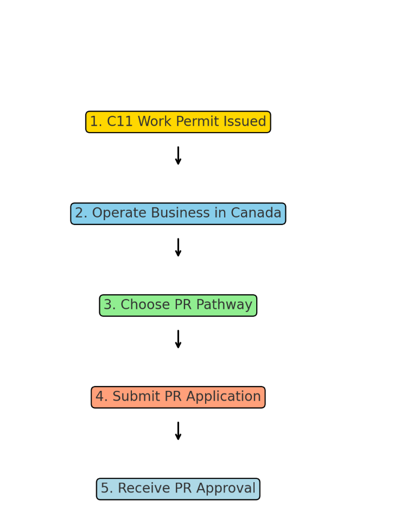
The C11 Work Permit is not just a temporary work solution—it is a strategic stepping stone toward obtaining Permanent Residency (PR) in Canada. Transitioning to PR requires a clear understanding of the available pathways and aligning your application strategy from the start
Eligibility Criteria for Transitioning to PR:
- Evidence of Canadian work experience or significant contributions made during the C11 Work Permit period.
- Proof of economic, cultural, or social benefits generated by the applicant’s business or work.
- Meeting the requirements of specific programs such as Express Entry, Provincial Nominee Programs (PNPs), or entrepreneur-focused streams.
Each pathway has unique eligibility requirements, making it essential to plan your transition early to align with the appropriate program.
With the C11 Work Permit, you’re not only building a foundation for your professional success in Canada but also creating opportunities to make a lasting impact—and ultimately achieve permanent residency.
Step-by-Step Process from C11 to Permanent Resident (PR)
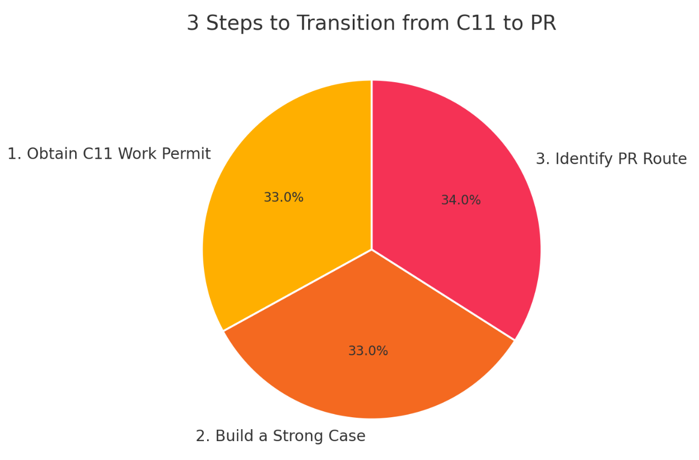
3 Steps to Transition from C11 to PR
Step 1: Secure the C11 Work Permit
Before transitioning to Permanent Residency (PR), the first step is obtaining the C11 Work Permit. The application process includes:
- Submitting a business plan that outlines the economic, cultural, or social benefits of your venture.
- Demonstrating significant control over your business operations.
- Providing supporting documents, such as financial investments, market research, and operational strategies.
Once approved, the C11 Work Permit is typically valid for two years, giving you ample time to establish your business in Canada.
Step 2: Strengthen Your Case During the C11 Period
While holding the C11 Work Permit, focus on building a strong foundation to enhance your eligibility for Permanent Residency. Key actions include:
- Generating Economic Impact: Create jobs for Canadians, increase local revenue, or introduce innovative products or services.
- Achieving Business Milestones: Showcase measurable success, such as profitability or market growth.
- Contributing to the Community: Highlight your social or cultural contributions, such as supporting local initiatives or engaging with community projects.
Your achievements during this phase will play a crucial role in strengthening your PR application.
Step 3: Choose Your Pathway to Permanent Residency (PR)
There are several pathways to transition from a C11 Work Permit to Permanent Residency:
Entrepreneur Pathway
This route is ideal for business owners who have successfully operated a business in Canada during their C11 period. Key options include:
- Provincial Nominee Programs (PNPs): Many provinces offer streams tailored to entrepreneurs who meet criteria such as investment thresholds, job creation, and operational success.
- Start-Up Visa Program: While distinct from the C11, transitioning to this program can provide PR if your business focuses on innovation and scalability.
Eligibility for Entrepreneur Streams:
- Minimum net worth (varies by province).
- Proven business management experience.
- Investment thresholds (typically CAD $150,000 to CAD $500,000, depending on the province).
- Demonstrated business performance through metrics like revenue, job creation, and market impact.
Required Documentation:
- Financial records showing investment and revenue generation.
- Proof of job creation for Canadian workers.
- Tax filings and payroll documentation.
- Business registration and licensing.
Provincial Nominee Program (PNP) Pathway
The PNP is a popular choice for C11 holders, as provinces actively seek entrepreneurs and self-employed professionals. Many provinces offer dedicated streams for business owners.
Eligibility Criteria:
- Residency in the nominating province.
- Proven business achievements, such as revenue generation and community contributions.
- Commitment to maintaining and growing the business in the province.
Application Process:
- Expression of Interest (EOI): Submit your business profile to the province.
- Invitation to Apply (ITA): Receive an ITA if your profile aligns with provincial priorities.
- Provincial Nomination: Secure a nomination certificate, which adds 600 Comprehensive Ranking System (CRS) points to your Express Entry profile.
Express Entry Pathway
For many skilled professionals and entrepreneurs, Express Entry remains the fastest route to PR. Relevant categories for C11 holders include:
- Canadian Experience Class (CEC): For those with at least one year of Canadian work experience.
- Federal Skilled Worker Program (FSWP): For applicants with foreign work experience and strong CRS scores.
By strategically leveraging the C11 Work Permit and aligning your efforts with the appropriate PR pathway, you can transition from temporary work status to permanent residency while building a thriving future in Canada.
How the C11 Work Permit Aligns with Express Entry
The C11 Work Permit can significantly enhance your Express Entry profile by contributing to key factors that boost your Comprehensive Ranking System (CRS) score:
- Canadian Work Experience: Operating a business under the C11 counts as valid Canadian work experience, which can increase your CRS points.
- Adaptability Factors: Active contributions to Canadian society, such as economic or cultural involvement, improve your overall CRS score.
- Provincial Nomination (PNP): Securing a provincial nomination through a PNP adds 600 CRS points, virtually ensuring an Invitation to Apply (ITA) for PR.
Transitioning to an LMIA-Integrated Pathway
While the C11 Work Permit is LMIA-exempt, some applicants may choose to transition to an employer-specific LMIA-based work permit if their business evolves into a formal employment arrangement. This option can provide additional opportunities for PR eligibility.
Advantages of an LMIA-Based Pathway:
Strengthens your profile for PNPs or Express Entry by formalizing your employment status.
Demonstrates successful integration into the Canadian economy.
Documents Required for an LMIA-Based Work Permit:
LMIA approval specific to the employer and job role (if applicable).
Updated employment contracts and financial documentation.
Documents Required for Permanent Residency Transition
Regardless of the PR pathway you pursue, the following documents are typically required:
Proof of Canadian Work Experience: Tax filings, payroll records, or business revenue statements that validate your work in Canada.
Business Financial Documentation: Bank statements, investment records, and revenue reports demonstrating the financial health of your business.
Evidence of Community Contributions: Letters of support from community organizations or testimonials highlighting your impact.
Educational Credentials: Educational Credential Assessments (ECAs) for any foreign qualifications.
Language Proficiency Results: Valid IELTS or CELPIP scores to meet language requirements.
Identity and Travel Documents: A valid passport, work permit, and any previous immigration records.
Key Considerations During Your PR Transition
Maintaining Legal Status:
Ensure your C11 Work Permit remains valid throughout the PR application process. If necessary, apply for extensions to avoid disruptions in your status.
Adhering to Provincial Requirements:
For those applying through a PNP, follow the province’s residency and operational requirements to maintain eligibility.
Responding to IRCC Requests:
Be prepared to provide additional documentation if requested by IRCC. Respond promptly and comprehensively to avoid delays in the PR process.
By aligning your C11 work and contributions with Express Entry or PNP pathways, you can streamline your transition to permanent residency while solidifying your role in Canada’s economy and society.
How Visapath Can Help You Secure a C11 Work Permit
Navigating Canada’s complex immigration system can be challenging, but Visapath is here to make it seamless. With over 20 years of experience and a proven track record of success, we specialize in helping entrepreneurs, self-employed professionals, and visionaries obtain the C11 Work Permit to start their journey in Canada.
Why Choose Visapath for Your C11 Work Permit?
Comprehensive Eligibility Assessment
A strong application begins with a thorough evaluation of your profile. We ensure you meet all the criteria for the C11 Work Permit by assessing:
- Your entrepreneurial or self-employment background.
- The viability and potential impact of your proposed business in Canada.
- Supporting documentation to substantiate your qualifications and intentions.
Whether you’re an entrepreneur with an innovative idea or a professional contributing to Canada’s cultural or economic landscape, we’ll craft a personalized strategy to maximize your chances of approval.
Tailored Business Plan Support
A compelling business plan is the backbone of any C11 application. While we’re not professional business planners, we provide proven templates that meet IRCC standards and have been widely accepted.
- Templates guide you in preparing market analysis, financial projections, and operational strategies to demonstrate your venture’s viability.
- Our experience ensures your business plan effectively highlights the economic, cultural, or social benefits of your work.
This approach saves you time and money while providing the tools you need to build a persuasive business plan.
Assistance with Supporting Documentation
The C11 application process demands thorough and precise documentation. Missing or incomplete paperwork can lead to delays or denials. We assist with:
- Preparing evidence of past business achievements or self-employment credentials.
- Drafting letters of intent and partnership agreements.
- Collecting market research and community impact studies to substantiate your claims.
- Ensuring all documents meet IRCC’s rigorous requirements.
Our meticulous attention to detail ensures that every aspect of your application is complete and professional.
Legal Representation
The immigration process can be daunting, especially when unexpected challenges arise. Our experienced legal team:
- Represents your case before Immigration, Refugees, and Citizenship Canada (IRCC).
- Responds promptly to procedural fairness letters or requests for additional information.
- Advocates on your behalf to resolve misunderstandings or obstacles.
With our legal expertise, you can navigate the process with confidence and minimize unnecessary stress.
Guidance on Transitioning to Permanent Residency (PR)
The C11 Work Permit is more than a temporary solution—it’s a pathway to permanent residency. At Visapath, we:
- Help you leverage Canadian work experience to boost your Express Entry profile.
- Assist with provincial nomination applications, if applicable.
- Provide a roadmap to transition seamlessly from the C11 Work Permit to permanent residency.
Our end-to-end support ensures that your immigration goals are fully realized.
Why Clients Trust Visapath
Our clients consistently praise us for our expertise and dedication. Here’s what they have to say:
- Personalized Service: “They treated my case like it was their own and were always available to answer my questions.”
- Professionalism: “Visapath are true experts. My C11 Work Permit was approved faster than I expected!”
- Attention to Detail: “Every document, every timeline, and every step was handled meticulously. I couldn’t have done it without them.”
- High Success Rate: “I was refused by another consultant, but Visapath turned it around. Now I’m running my business in Toronto!”
With hundreds of 5-star reviews on Google, our reputation speaks for itself.
Ready to Get Approved? Let’s Talk.
How VisaPath Can Help
At VisaPath, our representatives are highly successful with Owner-
Operator Work Permit applications and understand all the ins and outs.
We can guide you through each step of the process to ensure you compile a strong, convicting and complete application to give you
the best chances of success.

Frequently Asked Questions
What is a C11 Work Permit in Canada?
The C11 Work Permit is a specialized category under Canada’s International Mobility Program, designed for entrepreneurs, self-employed individuals, and others who can demonstrate significant economic, social, or cultural benefits to the country. It is LMIA-exempt, making it quicker and more accessible for eligible applicants
Who is Eligible for a C11 Work Permit?
To qualify for a C11 Work Permit, you must:
- Be an entrepreneur looking to start or expand a business in Canada.
- Be a self-employed professional, such as an artist, consultant, or IT specialist, contributing to Canada’s economy, culture, or society.
- Have innovative ideas, significant control over your work, and the ability to generate tangible economic or cultural benefits.
What is C11 Status in Canada?
C11 status refers to holding a valid work permit under the C11 category. This status allows you to operate a business or work independently in Canada on a temporary basis, while also providing opportunities to transition to permanent residency.
How Does the C11 Work Permit Differ from the C10?
- C10 Work Permit: Focuses on individuals who bring significant economic, social, or cultural benefits to Canada but are not necessarily entrepreneurs.
- C11 Work Permit: Specifically caters to entrepreneurs and self-employed professionals who plan to establish or operate businesses in Canada.
Both are LMIA-exempt but target different applicant profiles.
What is C11 Immigration Status?
C11 immigration status is a temporary designation for individuals holding a C11 Work Permit. It allows them to live and work in Canada temporarily, with the possibility of transitioning to permanent residency.
Do I Need Sponsorship for a C11 Work Permit?
No, the C11 Work Permit does not require employer sponsorship. It is an independent application based on your entrepreneurial or professional credentials.
Who is Eligible for a Skilled Worker Visa?
Eligibility for a skilled worker visa under programs like Express Entry includes:
- Meeting requirements for education, language proficiency, and work experience.
- Scoring well under the Comprehensive Ranking System (CRS).
- Having a job offer or a provincial nomination, though these are optional.
How Long Does It Take to Process a C11 Work Permit?
Processing times vary depending on the applicant’s country of residence and the complexity of the application. On average, it takes 2–4 months, though delays may occur if additional documents are requested or during high application volumes.
Can I Start a Business with a Work Permit?
Yes, the C11 Work Permit is specifically designed for individuals to start or manage their businesses in Canada, making it an ideal choice for entrepreneurs.
What is the C11 Program?
The C11 is an LMIA-exempt work permit stream under the International Mobility Program. It is designed for entrepreneurs and self-employed individuals who provide significant economic, cultural, or social benefits to Canada.
Who Can Apply for an LMIA-Exempt Work Permit?
LMIA-exempt work permits are available to individuals who:
- Qualify under the International Mobility Program (e.g., C11).
- Meet conditions for intra-company transfers, academic exchanges, or reciprocal employment agreements.
- Demonstrate significant benefit to Canada under programs like C10 or C11.
Who Can Sponsor Work Permits in Canada?
Employers can sponsor work permits by obtaining an LMIA, proving no Canadians are available for the role. For LMIA-exempt permits like C11, individuals apply independently without employer sponsorship.
What Can I Do if My Work Permit is Denied?
If your work permit is denied, you can:
- Request reconsideration if there is an error in the decision.
- Reapply with stronger documentation or address the reasons for refusal.
- Seek legal advice and consider a judicial review to challenge the decision.
Can Owning a Business Lead to Permanent Residency?
Yes, owning a business in Canada can lead to PR through:
- Provincial Nominee Programs (PNPs): Tailored streams for entrepreneurs.
- Express Entry: If your business experience aligns with program criteria.
- Other Pathways: Including the Start-Up Visa or Self-Employed Persons Program.
How Much Money Do I Need to Start a Business in Canada?
The required capital depends on your business type and location:
- Small businesses typically require CAD $50,000–$100,000.
- Provincial entrepreneur PNP streams may require investments ranging from CAD $150,000 to $600,000.
You will also need proof of settlement funds to support yourself and your family while establishing your business.