
Express Entry to Canada
Express Entry Unlocked: The No-Nonsense Guide to Immigrating to Canada
Welcome to the ultimate Express Entry playbook—your one-stop resource to navigating
Canada’s most sought-after immigration system. This guide breaks down every key detail you
need, equips you with strategies to maximize your CRS score, and helps you dodge common
pitfalls that could slow down your application.
By the time you finish reading, you won’t just understand Express Entry—you’ll be ready to
dominate it.
What is Express Entry?
Express Entry is Canada’s streamlined, digital immigration system that fast-tracks Skilled Workers to permanent residency. Introduced in 2015, it’s a points-based system that ranks applicants in a pool based on factors like work experience, education, and language ability.
Think of it like a competitive game—only instead of scoring goals, you’re racking up CRS points (more on that later). If you rank high enough, you get an invitation to apply (ITA) for PR, putting you one step closer to calling Canada home.

Why Choose Express Entry?
So, what makes Express Entry the gold standard for skilled immigration? Here’s why thousands of applicants go for it every year:
Lightning-Fast Processing: Most successful applications get approved within six months—one of the fastest pathways to Canadian PR.
Multiple Pathways: Express Entry isn’t one-size-fits-all—it manages three immigration programs, catering to different types of skilled workers:
- Federal Skilled Worker Program (FSWP) – For professionals with foreign work
experience. - Federal Skilled Trades Program (FSTP) – For skilled trades workers.
- Canadian Experience Class (CEC) – For applicants with Canadian work experience.
Transparent & Predictable: The Comprehensive Ranking System (CRS) gives you a clear idea of where you stand and how to improve your score. Plus, regular Express Entry draws let you track trends and strategize your application.
Path to Citizenship: Express Entry isn’t just about PR—it’s the first step towards becoming a Canadian citizen.
Express Entry Routes
Before getting started, it is important to determine whether you are eligible to apply under one or more of the three programs.
Express Entry is available to those applying under the following 3 immigration programs. Before getting started, it is important to determine whether you are eligible to apply under one or more of the three programs.
- Federal Skilled Worker Program you must have at least one year of continuous full-time or equivalent paid work experience in the past 10 years. Find out more about the Federal Skilled Worker Program.
- Federal Skilled Trade Program you must have at least two years of skilled work experience in the last five years. Find out more about the Federal Skilled Trade Program.
- Canadian Experience Class you must have at least one year of skilled worker experience in the last three years inside Canada. Find out more about the Canadian Experience Class.
Express Entry Eligibility: Do You Qualify?
Before diving in, you must check if you meet the minimum requirements. Let’s break it down, program by program.
Federal Skilled Worker Program (FSWP) – The Path for Professionals
To qualify under Federal Skilled Worker Program (FSWP), you must meet the following criteria:
| Requirement | Minimum Standard |
| Work Experience | At least 1 year of continuous full-time (or equivalent part-time) work in a skilled occupation within the last 10 years |
| Language Proficiency | Minimum CLB 7 in English or French |
| Education | High school diploma or higher |
| Selection Grid Score | At least 67 points out of 100 |
Work Experience: Do You Have the Right Job Background?
✅ Minimum Requirement: At least one year of continuous, full-time work experience (or the part-time equivalent) in an eligible occupation.
✅ Eligible Occupations: Your work must fall under one of the following National Occupational Classification (NOC) skill levels:
- NOC 0 → Managerial roles (e.g., marketing director, restaurant manager).
- NOC A → Professional jobs (e.g., software engineers, doctors, architects).
- NOC B → Skilled trades and technical roles (e.g., electricians, plumbers, chefs).
Example: Priya, a software developer, worked full-time (40 hours/week) for two years. Since her job falls under NOC A, she meets the work experience requirement. Had she worked part-time (20 hours/week), she would have needed two years of work to qualify.
Education: The More You Have, the Better
✅ Minimum Requirement: High school diploma or higher.
✅ Foreign Degrees: Must be assessed through an Educational Credential Assessment (ECA) to confirm they match Canadian standards.
✅ Higher Degrees = More CRS Points: Bachelor’s, Master’s, and PhD degrees add significant points to your CRS score.
Example: Sarah holds a Bachelor’s degree from India. She submits her documents to World Education Services (WES) for an ECA, which confirms her degree is equivalent to a Canadian Bachelor’s. This boosts her CRS score, increasing her chances of getting an ITA.
Language Proficiency: Your Key to Higher CRS Points
✅ Minimum Requirement: CLB 7 in all four skills:
- Listening: 6.0
- Reading: 6.0
- Writing: 6.0
- Speaking: 6.0
✅ Accepted Tests:
- English: IELTS or CELPIP
- French: TEF or TCF
Example: Raj scored Listening 6.5, Reading 6.0, Writing 6.0, and Speaking 6.5 on his IELTS test. That gives him a CLB 7, meaning he meets the FSWP requirement.
💡 Pro Tip: Higher language scores = more CRS points. If your score is on the lower end, consider retaking the test to boost your chances.

How Express Entry Works
Stage 1
Create your Profile
The first step is to create your profile. This step does not require uploading or providing any documents.
To create your profile, you will require the following:
The NOC is a specific code assigned to different occupations. Finding the best suited NOC is based on your job duties, and not your job title. When creating your Express Entry profile, you will be asked to assign a specific NOC code to your work experience(s). The three main NOC categories are Type 0 (management), Type A (professional occupations) and Type B (technical occupations).
It is important to choose the NOC closest to your job duties, since you will be required to provide an employment letter which includes the specific NOC duties in Stage 2 of the Express Entry application.
If you obtained your education anywhere except Canada, you would need to obtain an Educational Credential Assessment. This will assess your foreign education and provide you with the Canadian equivalency.
The most used ECA organization is the World Education Services (WES). There are specific professions, such as physicians, which are required to use a specific organization (ex. Medical Council of Canada).
English and/or French Language Test
You will be required to complete a language skills exam to assess your language ability, in either English or French. The test scores will determine how many points you are awarded and will help you determine which immigration stream you are eligible for.
For English exams, you can sign up with either IELTS (General Training) or CELPIP (General Test).
For French exams, your can sign up with either TEF Canada or TCF Canada.
Submitting your Stage 1 Profile
Before submitting your Express Entry profile, it is important to ensure all the information within the profile is not only accurate but can be supported with documentation.
Once you submit your profile, you will be placed in a pool of candidates. On a bi-weekly basis, invitations are sent out to applicants who meet the minimum point requirement for that specific draw. Each draw has a minimum point requirement. If you received an Invitation to Apply, you will proceed to Stage 2, which will require you to upload documentation in support of your Stage 1 Express Entry profile.
Stage 2
Invitation to Apply – Permanent Residency
After receiving an Invitation to Apply, you will be given 60 days to compile all necessary documentation to support your Express Entry Profile. All supporting documentation will be uploaded to your Express Entry profile. No originals are required.
Examples of Work Experience Documentation
For each work experience claimed in your Express Entry profile, you will need to provide proof of employment throughout the entire period. These include:
- Pay stubs
- Taxation documents (ex. T4, Notice of Assessment)
- Employment Reference Letters.
- Degrees/Diplomas
- Transcripts
- Confirmation Letter from School
Submitting your Stage 2 Profile
Government Fees
As of April 30, 2020, the application fees for Express Entry are as follows:
- Application fee ($825) and Right of Permanent Residence ($500): Total -$1325
- Spouse or partner (if any) – $1325
- Dependent child (if any) – $225 per child
- Biometrics Fee: $85per person (over 18 years of age)
While you are waiting for your Stage 2 – Permanent Residency application, you may be eligible to apply for a bridging open work permit, which will allow you to work in Canada until a decision is received on your application.
How to Apply for Express Entry
Once you’ve confirmed that you meet the eligibility criteria, here’s how you get started:
- Take Your Language Test – Get your IELTS/CELPIP (English) or TEF/TCF (French) scores.
- Get an Educational Credential Assessment (ECA) – Verify your foreign degree.
- Create Your Express Entry Profile – Enter your details into Canada’s IRCC portal.
- Receive a CRS Score – Based on your profile, you’ll be ranked against other candidates.
- Monitor Express Entry Draws – Check if you meet the cut-off score in upcoming rounds.
- Get an Invitation to Apply (ITA) – If you’re selected, you’ll have 60 days to submit a complete PR application.
- Wait for Processing – Most applications are processed within six months.
Mastering the Federal Skilled Worker Program (FSWP)
If you’re eyeing Express Entry, your first major milestone is meeting the Federal Skilled Worker Program (FSWP) requirements. Think of it as your golden ticket into Canada’s immigration system. Every factor—work experience, language proficiency, education, and selection grid score—acts as a gatekeeper, determining whether you get in or stay out.
Here we doesn’t just break down what’s required—it shows you how to optimize every factor to boost your chances of securing an Invitation to Apply (ITA).
Let’s dive in.
Step 1
Work Experience—The Backbone of Your FSWP Profile
Work experience is more than just a checkbox—it’s proof of your professional value to Canada. The right experience can make or break your eligibility, so it’s essential to understand how it works.
✅ Minimum Requirement: At least 1 year of continuous, full-time (or equivalent part-time) work in a skilled occupation within the last 10 years.
✅ Eligible Occupations: Your job must fall under Canada’s National Occupational Classification (NOC) system, specifically:
- NOC 0 → Managerial roles (e.g., marketing director, project manager).
- NOC A → Professional jobs (e.g., software engineers, doctors, accountants).
- NOC B → Skilled trades and technical roles (e.g., electricians, chefs, welders).
How to Strengthen Your Work Experience
- Show Consistency: One uninterrupted year of full-time work (or the equivalent in part-time) is a must. Gaps in employment? You’ll need to explain them in your profile.
- Diversify Your Experience: Having work experience across different roles or countries can showcase adaptability, which is valued in Canada’s labor market.
- Ensure NOC Accuracy: Misclassifying your NOC code is a top reason for application refusals. Cross-check your job title and job duties against the official NOC database.
Case Study: Work Experience Done Right
Example: Priya, a software developer, worked full-time (40 hours/week) for two years in an NOC A role. Since she meets the minimum one-year requirement, she qualifies. However, if she had worked part-time (20 hours/week), she would need two years to equate to one full-time year.
Step 2
Language Proficiency—Your Ticket to Higher CRS Points
Strong language scores don’t just help you meet FSWP eligibility—they’re also one of the biggest CRS point boosters in Express Entry.
✅ Minimum Requirement: CLB 7 in English or French in all four skills:
- Listening: 6.0
- Reading: 6.0
- Writing: 6.0
- Speaking: 6.0
✅ Accepted Tests:
- English: IELTS or CELPIP
- French: TEF or TCF
Why Language Scores Matter More Than You Think
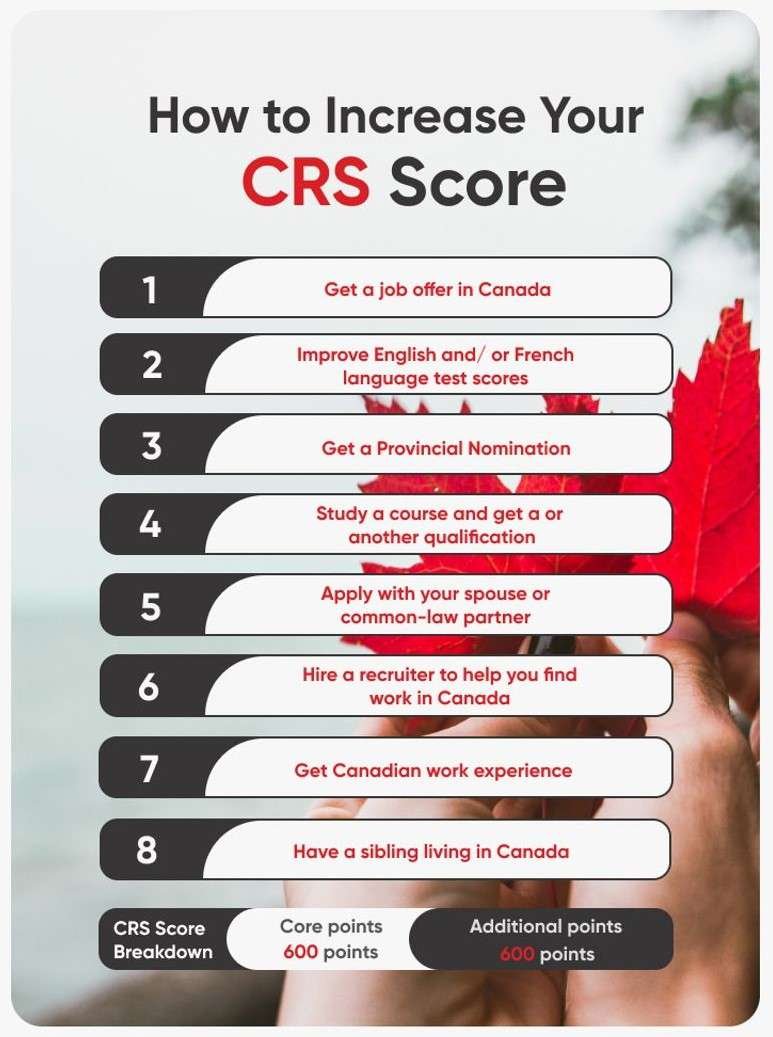
- Language is worth up to 160 CRS points (core factors) + additional points for French proficiency.
- Higher benchmarks unlock extra points in combination with Canadian work experience or education.
- If you hit CLB 9+, your CRS score skyrockets.
How to Boost Your Language Score
- Retake the IELTS or CELPIP after targeted preparation to hit CLB 9 or higher.
- Join intensive language training—focus on weaker areas like writing and speaking.
- Consider learning French—you could earn up to 50 extra CRS points for bilingual proficiency.
Case Study: Language Score Power Play
Example: Arjun originally scored CLB 7 on IELTS. After retaking the test and hitting CLB 9, his CRS score jumped by 72 points, pushing him into the competitive range for an ITA.

Step 3
Education—Maximize Your CRS Potential
Education plays a dual role in Express Entry—it makes you eligible for Federal Skilled Worker Program (FSWP) and heavily impacts your CRS score.
✅ Minimum Requirement: A high school diploma or higher.
✅ Foreign Degrees: Must be evaluated through an Educational Credential Assessment (ECA) to ensure they match Canadian standards.
✅ Higher Degrees = More CRS Points:
- A Bachelor’s Degree gets you more points than a high school diploma.
- A Master’s or PhD maximizes your CRS score and strengthens your PNP options

How to Optimize Your Education Credentials
- Complete short-term Canadian certifications—even a diploma or online course can add CRS points.
- Ensure your ECA is accurate—sometimes, providing additional documentation can lead to a better equivalency result.
- Check your ECA report carefully—mistakes in evaluation can mean lost points.
Case Study: Education Done Right
Example: Sarah, a finance professional, holds a Master’s degree from India. She submits her credentials to WES for an ECA, confirming her degree is equivalent to a Canadian Master’s—which significantly increases her CRS score.
Step 4
NOC Classification & ECA Reports—Your Secret Weapons
Understanding NOC codes and ECA reports can make or break your Express Entry journey.
NOC Classification: Avoid Costly Mistakes
✅ Why It Matters:
- Your NOC code must align with your job title and duties—misclassification can lead to rejections.
- ESDC verifies job descriptions, so your employer must confirm duties that match your NOC code.
✅ How to Get It Right:
- Cross-reference your job title with the NOC database.
- Ensure your reference letters clearly match the NOC-defined duties.
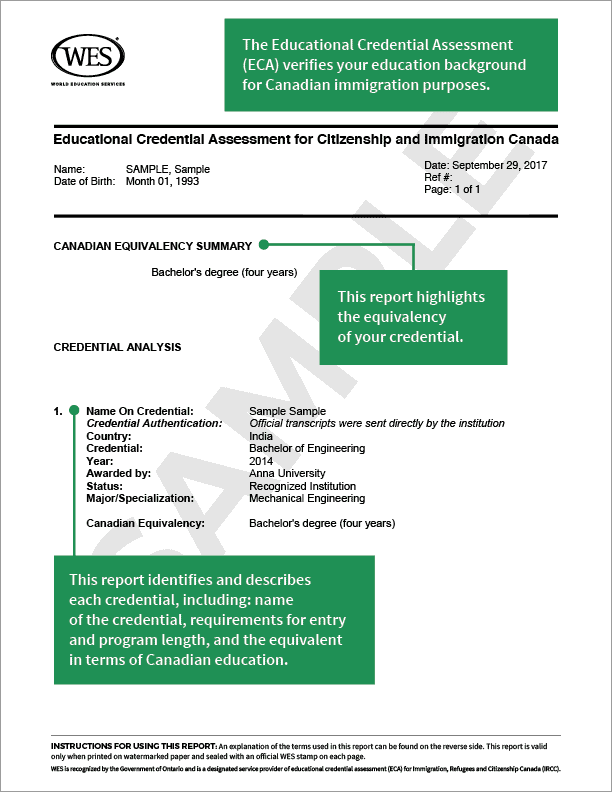
ECA Reports: Validate Your Education for Maximum Points
✅ Why It Matters:
- Foreign education must be verified to be eligible for FSWP points.
- The right ECA report ensures your education maximizes your CRS score.
✅ How to Use It:
- Submit your degree to a designated organization like WES, IQAS, or ICES.
- If your ECA comes back lower than expected, request a re-evaluation with additional documentation.
Step 5
Strategic Planning for Express Entry Success
Meeting FSWP requirements gets you into Express Entry, but winning the game means securing an ITA. Here’s how to play smart:
Prioritize High-Impact Areas
- Language scores and education yield the most CRS points—invest in them.
- Address weak areas early—e.g., gain additional work experience or enroll in training programs.
Leverage Provincial Nominee Programs (PNPs)
- Many PNPs lower their language and CRS requirements, offering a shortcut to PR.
- Apply strategically to provinces seeking your skills.
Stay Ahead of Trends
- Follow CRS draw trends & NOC updates—Express Entry changes frequently.
- Regularly update your profile for every possible CRS boost.
Final Takeaway: Success Starts with Smart Planning
The Federal Skilled Worker Program (FSWP) is your gateway to Express Entry—but success comes down to strategy. Maximizing your CRS score, optimizing your profile, and staying ahead of updates are the keys to securing an ITA and achieving Canadian PR.
🔹 Want to boost your score? Focus on language, education, and strategic job selection.
🔹 Need expert help? A small tweak in your profile could mean the difference between waiting and winning.
Your Canadian dream is closer than you think—let’s make it happen!
Express Entry Success: Requirements & Document Checklist
Applying for Express Entry isn’t just about hitting eligibility requirements—it’s about strategic planning, flawless documentation, and maximizing your CRS score. Every factor, from language proficiency to financial proof, plays a critical role in securing your Invitation to Apply (ITA).
This guide not only walks you through the essential requirements but also shows you how to strengthen your profile and avoid costly mistakes.
Step 1: Laying the Foundation—Meet Federal Skilled Worker Program (FSWP) Requirements
✅ The First Milestone: Before even entering the Express Entry pool, you must meet FSWP eligibility. Think of this as your entry ticket to the game.
What You Need to Qualify:
🔹 Work Experience
✔ At least 1 year of continuous, full-time work (or equivalent part-time) in a skilled job.
✔ Eligible NOC categories:
- NOC 0 – Managerial roles (e.g., Operations Director, HR Manager).
- NOC A – Professional roles (e.g., Engineers, Accountants, Doctors).
- NOC B – Skilled Trades & Technical roles (e.g., Electricians, Chefs, Welders).
💡 Pro Tip: Aligning your job duties with the correct NOC code is crucial—misclassification can lead to rejections!
🔹 Language Proficiency
✔ Minimum CLB 7 in English or French (Listening 6.0, Reading 6.0, Writing 6.0, Speaking 6.0).
✔ IELTS, CELPIP, TEF, or TCF results—must be less than 2 years old.
💡 Pro Tip: Scoring CLB 9 or higher in language tests dramatically boosts your CRS points!
🔹 Education
✔ High school diploma or higher—Canadian equivalent required.
✔ ECA Report from WES, IQAS, or ICES proving your foreign degree matches Canadian standards.
💡 Pro Tip: Higher education (Bachelor’s, Master’s, PhD) gives major CRS point advantages.

Step 2: Prioritizing High-Impact Areas to Maximize CRS Points
Meeting FSWP requirements is just the beginning—to actually get an ITA, you need to maximize your CRS score. Two factors have the most impact:
🔹 Language Proficiency: The Game-Changer
💥 Worth up to 160 CRS points (even more with a spouse or second language).
💥 French proficiency adds up to 50 extra points—a major boost!
How to Improve:
✔ Retake IELTS/CELPIP/TEF if your score is low—CLB 9+ unlocks major bonus points.
✔ Enroll in intensive language training—invest in professional coaching.
✔ Improve your weakest area (speaking, writing, listening) to boost overall score.
🔹 Education: The Second Biggest CRS Booster
💥 Worth up to 150 CRS points!
💥 A Master’s or PhD can dramatically increase your rank in the pool.
How to Optimize:
✔ Get your ECA done ASAP—this takes weeks, so don’t delay!
✔ Consider Canadian certifications or diplomas to add extra points.
✔ If you’re married, get your spouse’s ECA too—it can boost your total CRS score.
Step 3: Strategic Use of NOC Codes & ECA Reports
Canada uses National Occupation Classification (NOC) codes to assess work experience, and Educational Credential Assessments (ECA) to evaluate foreign degrees. These two tools can make or break your eligibility.
🔹 Using NOC Codes Correctly
✔ Choose the NOC code that accurately reflects your job duties—not just your job title.
✔ Reference letters from employers must clearly describe duties matching NOC descriptions.
✔ Misclassification = LMIA refusal or PR rejection!
🔹 Educational Credential Assessments (ECA): The Key to Recognition
✔ Required for all applicants with foreign education.
✔ Submit through WES, IQAS, or ICES.
✔ If ECA results seem lower than expected, request a re-evaluation with additional documentation.
💡 Pro Tip: Some ECAs recognize graduate diplomas as Master’s degrees—which means higher CRS points!
Step 4: Mastering Your Express Entry Document Checklist
Submitting the right documents at the right time is just as important as meeting the eligibility criteria. Missing a single document can delay or even reject your application.
Why Does This Matter?
✔ Documents validate your claims—without proof, your CRS score is meaningless.
✔ IRCC reviews each document carefully—errors or missing files raise red flags.
Essential Documents for Express Entry
- Identity & Personal Information
📌 Passport (valid, unexpired, with all travel stamps & visas).
📌 Birth Certificate (if applicable).
📌 Marriage Certificate (for married/common-law applicants).
2. Language Test Results
📌 IELTS, CELPIP, TEF, or TCF (valid for less than 2 years).
💡 Pro Tip: Keep original test results handy—IRCC may request verification.
3. Educational Credentials
📌 Degree, diploma, and certificates (certified copies).
📌 ECA report from WES, IQAS, or ICES confirming Canadian equivalency.
4. Proof of Funds
📌 Recent bank statements (covering at least 6 months).
📌 Investment statements (GICs, stocks, mutual funds).
📌 Letter from your bank confirming account details.
💡 Pro Tip: Ensure your funds meet IRCC’s minimum settlement amount for your family size.
5. Employment History
📌 Reference letters on company letterhead with job duties, salary & tenure.
📌 Pay stubs or tax documents for verification.
6. Police Certificates & Medical Exam
📌 Police clearance for every country you’ve lived in for 6+ months since turning 18.
📌 Medical exam by an IRCC-approved physician.
💡 Pro Tip: Police certificates must be less than 6 months old when you apply.
7. Travel History
📌 Copies of past visas & travel stamps.
📌 List of international trips taken in the last 10 years.
8. Additional Supporting Documents (If Applicable)
📌 Provincial Nomination Certificate (for PNP applicants).
📌 Job Offer & LMIA approval (if applicable).
📌 Proof of sibling in Canada (PR card, citizenship).
Step 5: Smart Strategies for Long-Term Success
💡 Want to fast-track your PR?
✔ Target CLB 9+ in language tests for max CRS points.
✔ Leverage PNP programs—some require lower CRS scores than Express Entry.
✔ Stay updated on Express Entry trends & modify your profile as needed.
Your Canadian dream is within reach—let’s make it happen!
Mastering Your Express Entry Documents
Step 1: Master the Art of Document Organization
Submitting documents isn’t just about uploading files and hoping for the best. The way you present your paperwork matters. IRCC processes thousands of applications, and if your documents are messy, mislabeled, or hard to read, your application can be flagged for additional review—or worse, refused.
How to Structure Your Documents for Success:
- Follow IRCC’s Order: Arrange your documents in the exact order required by Immigration, Refugees, and Citizenship Canada (IRCC). This ensures a smooth review process and prevents unnecessary back-and-forth.
- Label Everything Clearly: Use clear, professional filenames when scanning and uploading. Example: “Passport_FirstName_LastName” instead of “scan12345.”
Group Multi-Page Documents Together: If a document has multiple pages (like a degree transcript or reference letter), combine it into a single PDF instead of uploading separate pages.

Step 2: High-Quality Scans Are Non-Negotiable
Blurry, low-resolution scans are a red flag. IRCC needs clear, legible documents, and anything that looks altered or difficult to read could trigger requests for resubmission or, in worst cases, rejection.
Best Practices for Scanning Your Documents:
- Scan in color and at high resolution (at least 300 DPI).
- Avoid shadows, glares, or cropped edges. The entire document must be visible.
- Save files as PDFs. Avoid submitting images (JPG, PNG) unless IRCC specifically requests them.
- Double-check before uploading. A single missed page or unreadable document could derail your application timeline.
Step 3: Translate Any Non-English/French Documents the Right Way
If any of your documents are in a language other than English or French, they must be professionally translated. IRCC has strict rules about translations—any failure to comply could invalidate your application.
Translation Requirements:
- Use a Certified Translator. Machine translations or informal translations by friends or family are not accepted.
- Include an Affidavit of Translation. This document confirms the translator’s qualifications and the accuracy of the translation.
Submit Both Versions. You must provide both the original document and the certified translation—never submit only the translated version.
Express Entry Documents Checklist: What You Need to Submit
- Identity Documents
- Valid passport (including all pages with stamps or visas).
- Birth certificate (if applicable).
- Marriage certificate (if applying with a spouse or common-law partner).
- Language Proficiency Proof
- IELTS (General Training), CELPIP (General), TEF, or TCF results.
- Test results must be valid (less than two years old).
- Educational Credentials
- Degree(s), diploma(s), and transcripts (originals or certified copies).
- Educational Credential Assessment (ECA) report from WES, IQAS, or another designated organization.
- Proof of Funds
- Bank statements covering the last six months.
- Investment statements (GICs, stocks, mutual funds).
- Letter from your financial institution confirming your account balance and history.
- Employment History Documents
- Reference letters from past employers (must be on company letterhead, include roles, responsibilities, and exact employment dates).
- Pay stubs or tax documents as supporting evidence of employment.
- Signed employment contracts (if available).
- Additional Proofs (If Required)
- Police clearance certificates from every country where you’ve lived for six months or more since the age of 18.
- Medical examination results from an IRCC-approved panel physician.
- Proof of provincial nomination (if applying through a PNP).
- Job offer and LMIA approval (if applicable).
Final Tips to Strengthen Your Express Entry Application
- Start collecting documents early. Some, like police certificates and ECA reports, take weeks to process—waiting until the last minute can cause delays.
- Verify document expiration dates. Ensure your passport, language test results, and police certificates are valid at the time of submission.
- Stay organized. Keep digital and physical copies of every document. If IRCC requests additional proof, you’ll have everything ready to go.
- Double-check IRCC’s latest requirements. Immigration policies evolve—always refer to the most up-to-date document checklist before submitting.
Final Thoughts: The Right Documents Can Make or Break Your Express Entry Success
Meeting the Federal Skilled Worker Program (FSWP) eligibility criteria is just the beginning. Submitting a well-organized, complete, and high-quality document package is what secures your spot in the Express Entry pool and helps you move closer to Canadian PR.
A single missing document can delay your processing time or even lead to rejection—but with the right preparation, you can avoid unnecessary setbacks and maximize your chances of success.
Now that you know exactly what you need, it’s time to get your documents in order and take control of your Express Entry journey.
Overcoming Criminal Inadmissibility for Express Entry: Your Path to a Fresh Start
A criminal record doesn’t have to mean the end of your Canadian immigration journey. While past offenses can create barriers to entering or staying in Canada, there are clear pathways designed to help individuals overcome inadmissibility and move forward with Express Entry.
Canada recognizes that people can change, rehabilitate, and contribute positively to society, which is why Temporary Resident Permits (TRP) and Criminal Rehabilitation programs exist. If you’re serious about immigration, understanding how to clear your record in Canada’s eyes is key to unlocking your future as a permanent resident.
This guide breaks down:
- Why criminal inadmissibility matters for Express Entry.
- The options available to overcome it.
- How to improve your chances of success.
Why Criminal Inadmissibility is a Major Concern for Express Entry?
Express Entry is Canada’s competitive immigration system for skilled workers, but it has strict admissibility rules. Public safety is a top priority, and any criminal history—even for minor offenses—can result in inadmissibility.
How Inadmissibility Affects Your Application?
- Your Express Entry profile can be refused if you or any dependents (spouse, children) have a criminal record.
- Even non-violent offenses like DUIs, theft, or fraud can result in a rejection.
- Your inadmissibility applies even if the offense happened years ago in another country.
- Expunged or pardoned records may still be recognized under Canadian law.
Key Fact: Even if you meet the CRS score requirements, inadmissibility can block your Express Entry application entirely unless you take steps to resolve it.
How to Overcome Criminal Inadmissibility and Qualify for Express Entry?
If you have a criminal record, there are two main options to regain admissibility:
- Temporary Resident Permit (TRP) – A Short-Term Solution
- Criminal Rehabilitation – A Permanent Fix
Let’s explore how each one works.
1. Temporary Resident Permit (TRP)
If you need to enter Canada despite being inadmissible, a Temporary Resident Permit (TRP) can give you temporary access. However, this is not a long-term solution—it only allows entry for a specific purpose and timeframe.
What is a TRP?
- A special permit issued to individuals with criminal inadmissibility, allowing them to enter Canada for a valid reason.
- Approved when the benefits of your entry outweigh the potential risks to Canadian society.
- Not a guarantee—TRPs are granted on a case-by-case basis and require strong justification.
When Should You Apply for a TRP?
- If your offense was recent, and you’re not yet eligible for Criminal Rehabilitation.
- If you need to enter Canada urgently, for work, family, or medical reasons.
- If your job requires travel to Canada, such as a business meeting, conference, or employment contract.
TRP Validity & Renewal
- Can be issued for up to three years.
- Renewable if you continue to meet eligibility requirements.
- You must apply for a new TRP every time you want to enter Canada, unless issued a multiple-entry permit.
Example: How a TRP Works
Maria, a software developer, was offered a high-paying job in Toronto. However, a DUI conviction two years ago made her inadmissible. She applied for a Temporary Resident Permit, explaining that her skills were needed in Canada, and her offense was an isolated mistake. The TRP was granted for one year, allowing her to attend job interviews and transition into a long-term solution like Criminal Rehabilitation.

2. Criminal Rehabilitation: The Permanent Solution to Inadmissibility
Unlike a TRP, Criminal Rehabilitation is a long-term fix that restores your full eligibility for Express Entry. Once approved, your record will no longer be a barrier to entering Canada.
What is Criminal Rehabilitation?
- A legal process that removes inadmissibility permanently, proving that you are no longer a risk to Canadian society.
- After approval, you will not need a TRP to enter Canada.
- Ideal for offenses that occurred at least five years ago.
Who is Eligible for Criminal Rehabilitation?
To qualify, you must:
✔ Have committed an offense considered non-serious under Canadian law.
✔ Have completed all sentences, fines, probation, and community service at least five years ago.
✔ Demonstrate rehabilitation through a stable lifestyle, employment, and no repeat offenses.
How to Apply for Criminal Rehabilitation
Your application must include:
- A detailed personal statement explaining the offense, how your life has changed, and why you won’t reoffend.
- Police certificates from all countries you’ve lived in for six months or more since turning 18.
- Court documents proving the offense is closed and all fines or sentences are fully completed.
- Letters of reference from employers, community leaders, or family members demonstrating strong character and responsibility.
Example: How Criminal Rehabilitation Works
John, a finance professional, was convicted of theft over ten years ago. He has since built a successful career, completed community service, and has no further offenses. He applied for Criminal Rehabilitation, submitting employment records, letters from his employer, and police clearance certificates. After approval, he became fully eligible for Express Entry.
Final Steps: What to Do Next If You’re Criminally Inadmissible
- Determine the best solution for your situation.
- If your offense occurred less than five years ago, apply for a Temporary Resident Permit (TRP).
- If it’s been five years or more since you completed your sentence, Criminal Rehabilitation is your best option.
- Gather all necessary documents.
- Police clearances, court records, reference letters, and proof of rehabilitation.
- Work with professionals.
- Criminal inadmissibility cases can be complex—seeking legal advice or immigration professionals can increase approval chances.
- Monitor Express Entry requirements.
- Even after resolving inadmissibility, ensure you meet all other Express Entry eligibility criteria.
Conclusion: Overcoming Inadmissibility is Possible
A criminal record does not mean your Express Entry journey is over. Canada’s immigration system recognizes rehabilitation and provides clear pathways to overcome past mistakes.
By taking the right steps, gathering strong evidence, and demonstrating rehabilitation, you can successfully remove criminal inadmissibility and secure your future in Canada.
Your past does not define your future—if Canada is your goal, there is a way forward.
Navigating Canadian Inadmissibility: From Barriers to Express Entry Success
Key Insights:
- Inadmissibility ≠ Ineligibility – If you’re deemed inadmissible, it doesn’t automatically disqualify you from immigrating. Canada offers structured solutions such as the Temporary Resident Permit (TRP) and Criminal Rehabilitation to address these barriers.
- Time is critical – The sooner you initiate the resolution process, the better. Delays can have lasting consequences, particularly if you’re aiming for Express Entry. Take proactive steps to resolve inadmissibility as soon as possible.
- Post-clearance strategy – Once you’ve resolved your inadmissibility, shift your focus to maximizing your Comprehensive Ranking System (CRS) score. Enhancing your language proficiency, accumulating Canadian work experience, and securing a Provincial Nominee Program (PNP) invitation can dramatically improve your chances of selection.
Case Study: How Alex Overcame Inadmissibility and Secured Express Entry
Background
Alex, a highly skilled welder from the UK, had an assault conviction from 8 years ago, with his sentence completed 6 years prior. Despite being an ideal Express Entry candidate, this criminal history rendered him inadmissible to Canada.
Challenges
- Inadmissibility blocked his Express Entry eligibility.
- Delays could impact his opportunity to immigrate under the skilled worker category.
Solution
- Applied for Criminal Rehabilitation, submitting police clearance certificates, employment records, and character references.
- Once approved, he boosted his CRS score by retaking the IELTS and securing a PNP nomination.
Outcome
Within six months of resolving his inadmissibility, Alex received an Invitation to Apply (ITA) and is now successfully on his way to Canadian permanent residency.

Step-by-Step Guide to Determining and Resolving Inadmissibility
Step 1: Identify Inadmissibility
Common Reasons for Inadmissibility:
- Criminal convictions (e.g., DUI, theft, assault)
- Security concerns (e.g., espionage, terrorism links)
- Misrepresentation on immigration applications
Action Plan:
- Obtain police certificates from any country where you’ve lived for at least six months since turning 18.
- Cross-check your offense against Canada’s Criminal Code to determine if it qualifies as a serious crime under Canadian law.
- Example: A DUI that may seem minor in another country could be considered a serious offense in Canada, leading to inadmissibility.
Step 2: Select the Right Solution – TRP or Criminal Rehabilitation?
Once inadmissibility is confirmed, you need to decide which pathway to pursue:
Temporary Resident Permit (TRP):
- Purpose: Grants short-term entry despite inadmissibility.
- Best for: Urgent situations, such as job interviews or family visits.
- Eligibility:
- Requires a compelling reason for travel.
- Generally applies to offenses committed less than five years ago.
Criminal Rehabilitation:
- Purpose: Provides permanent clearance of inadmissibility.
- Best for: Long-term immigration plans, including Express Entry.
- Eligibility:
- At least five years must have passed since completing all aspects of your sentence (including probation, fines, etc.).
- Strong proof of rehabilitation, such as stable employment and no further offenses.
Step 3: Submitting a Strong Application
Both TRP and Criminal Rehabilitation applications require detailed documentation. Missing or incomplete paperwork is a common cause of rejections.
For a TRP Application, Include:
- IMM 5708 (TRP application form)
- Police certificates from all past residences
- A well-documented explanation of why the benefits of your entry outweigh the risks
- Supporting documents related to your visit (e.g., job offer, family invitation)
For a Criminal Rehabilitation Application, Include:
- IMM 1444 (Criminal Rehabilitation application form)
- Police and court records for all past offenses
- Evidence of rehabilitation, such as employment history and character references
- Proof that all fines were paid and sentences fully served
Step 4: Waiting for a Decision & Next Steps
Processing Times:
- TRP Applications: A few weeks to several months, depending on urgency.
- Criminal Rehabilitation: Typically 6-12 months, but can take longer.
What Happens Next?
- If granted a TRP, you’ll have temporary access to Canada but must comply with the permit’s conditions.
- If approved for Criminal Rehabilitation, your inadmissibility is permanently removed, making you fully eligible for Express Entry.
Example: Alex’s Criminal Rehabilitation application took 9 months to get approved. Once cleared, he seamlessly proceeded with his Express Entry profile.
Step 5: Moving Forward with Express Entry
Once inadmissibility is resolved, you can finally enter the Express Entry pool with confidence.
Key Considerations:
- Your police certificates should no longer list any unresolved criminal issues.
- Be prepared to submit proof of Criminal Rehabilitation approval or an active TRP if requested.
Pro Tip: If you received a TRP, start working toward Criminal Rehabilitation as a long-term solution to avoid future barriers.
Final Thoughts
Being deemed inadmissible doesn’t have to mean the end of your Canadian immigration journey. Whether you require a Temporary Resident Permit for short-term access or Criminal Rehabilitation for a permanent fix, strategic planning and prompt action are key. Once your inadmissibility is resolved, shift gears toward boosting your CRS score to maximize your Express Entry chances.
Canada values skilled talent. With the right approach, even past mistakes won’t keep you from securing a bright future in the country.
Why Maintaining Status is Crucial
When applying for permanent residency (PR) through Express Entry, maintaining valid legal status in Canada is non-negotiable. If your work permit is expiring or you’re awaiting a PR decision, you must stay compliant with immigration laws. Failing to do so can lead to:
- Removal from Canada due to unauthorized stay.
- Loss of eligibility for certain immigration programs.
- Delays in PR application processing.
To avoid these complications, temporary residents must explore available pathways, such as the Bridging Open Work Permit (BOWP), to continue working legally.
Bridging Open Work Permit (BOWP): Continue Working While Awaiting PR
What is a BOWP?
A Bridging Open Work Permit (BOWP) is designed for individuals already in Canada whose work permits are about to expire but have a pending PR application. This open work permit is not tied to a specific employer, allowing flexibility in employment while awaiting PR approval.
Who is Eligible for a Bridging Open Work Permit (BOWP)
To qualify for a Bridging Open Work Permit, applicants must meet the following criteria:
- Valid Work Permit Status: You must be in Canada on a valid work permit at the time of application.
- Submitted eAPR: Your electronic Application for Permanent Residence (eAPR) must be submitted under one of these programs:
- Expiring Work Permit: Your current work permit must be expiring within four months.
- Acknowledgment of Receipt (AOR): You must have received an Acknowledgment of Receipt (AOR) from Immigration, Refugees, and Citizenship Canada (IRCC).
Example Scenario:
Maria, a software engineer, submitted her eAPR through Express Entry. However, her current work permit expires in two months. To continue working legally, she applies for a BOWP, allowing her to remain employed while awaiting her PR decision.
Applying for a Bridging Open Work Permit (BOWP): Step-by-Step Process
Step 1: Gather Your Documents
To submit a strong BOWP application, you’ll need the following:
- A copy of your current work permit.
- Proof of submission of your eAPR (Acknowledgment of Receipt – AOR).
- A completed application form (IMM 5710).
- Payment of applicable fees ($255 total: $155 work permit fee + $100 open work permit holder fee).
Step 2: Submit Your Application Online
- Log in to your IRCC account.
- Select “Apply for a Work Permit.”
- Upload your required documents and pay the processing fee.
Step 3: Wait for Processing
- Processing times vary, but BOWP applications typically take 2-3 months.
- If additional documents are requested, submit them promptly to avoid delays.
Maintaining Status While Waiting for PR
If your work permit expires before your BOWP is processed, you may still be able to remain in Canada under Implied Status—meaning you can continue working under the same conditions until a decision is made on your application. However, if you’re not eligible for a BOWP, you may need to apply for a Visitor Record to maintain status in Canada legally.
Bottom Line: Don’t risk falling out of status while awaiting PR. If your work permit is expiring, explore options like the Bridging Open Work Permit to ensure uninterrupted legal residence and employment in Canada.
Federal Skilled Trades Program (FSTP): Why it Stands Out?
If you’re an experienced welder, plumber, electrician, heavy-duty mechanic, or any other skilled trades professional, the Federal Skilled Trades Program (FSTP) is tailor-made for you. Unlike other immigration streams that prioritize advanced degrees and high language proficiency, FSTP is all about practical expertise—if you have the skills Canada needs, this program can fast-track your permanent residency (PR).
Let’s break it all down into simple, actionable steps so you can maximize your chances of success.
Key Benefits of FSTP
- Skills Over Degrees: Your hands-on experience matters more than a university diploma.
- Lower Language Requirements: Achievable CLB 5/4 benchmarks (we’ll explain more below).
- Demand-Driven: Canada is actively seeking skilled trades professionals to fill labor shortages.
Express Entry Stream: Faster processing times compared to other economic immigration pathways.

Step 1: Confirm Your Eligibility
To apply under FSTP, you need to meet three core criteria: work experience, language proficiency, and either a job offer or trade certification.
- Work Experience – The Foundation of Your Application
To qualify, you must have:
✅ At least 2 years of full-time (or part-time equivalent) experience in a skilled trade within the last 5 years.
✅ Work experience that aligns with National Occupational Classification (NOC) B.
Eligible Trades Include:
- Industrial, Electrical, and Construction Trades: Welders, plumbers, electricians.
- Maintenance and Equipment Operation Trades: Heavy-duty mechanics, refrigeration technicians.
- Supervisors and Technicians: Roles in agriculture, natural resources, and mining.
Example: John, a heavy equipment mechanic from the UK, has three years of experience under NOC 7312—making him an ideal FSTP candidate.
- Language Proficiency – Practical and Achievable
FSTP does not require advanced English or French proficiency. The language benchmarks are realistic and job-focused.
✅ CLB 5 (Speaking & Listening) and CLB 4 (Reading & Writing)
IELTS Equivalents:
- Speaking: 5.0
- Listening: 5.0
- Reading: 3.5
- Writing: 4.0
Why This Matters: Even though these are lower thresholds, having good communication skills is crucial for workplace safety and effective teamwork. If your scores are low, consider retaking IELTS or CELPIP after some preparation to boost your Comprehensive Ranking System (CRS) score.
Step 2: Certification or Job Offer – One is Mandatory
To apply under FSTP, you must have either a job offer from a Canadian employer OR a Certificate of Qualification from a Canadian province/territory.
Option 1: Certificate of Qualification
✅ Issued by a provincial or territorial regulatory body.
✅ Confirms your skills meet Canadian standards.
Example: Anita, a plumber from India, applies for certification in Alberta. Once she passes the provincial skills assessment, she becomes eligible for FSTP without needing a job offer.
Option 2: Valid Job Offer
✅ Must be for a full-time position lasting at least one year.
✅ Helps boost your CRS score under Express Entry.
Certification vs. Job Offer Breakdown
|
Requirement |
Certificate of Qualification |
Valid Job Offer |
|
Issued By |
Provincial/Territorial Authority |
Canadian Employer |
|
Validation |
Confirms skills meet Canadian standards |
Employer-specific role |
|
CRS Impact |
No direct CRS points |
Can add up to 200 CRS points |
Step 3: Enter the Express Entry Pool
Once you’ve met the eligibility requirements, it’s time to create your Express Entry profile and maximize your CRS score.
✅ Gather Required Documents:
- Language test results (IELTS or CELPIP)
- Certificate of Qualification (if applicable)
- Valid job offer (if applicable)
- Proof of work experience
✅ Submit Your Express Entry Profile:
- Once in the pool, your profile will be ranked based on your CRS score.
- The higher your score, the greater your chances of receiving an Invitation to Apply (ITA) for PR.
✅ Improve Your CRS Score:
- Retake IELTS/CELPIP if your language scores are borderline.
- Gain additional work experience while in Canada.
- Secure a Provincial Nomination (PNP), which can add 600 CRS points and virtually guarantee an ITA.
Step-by-Step Guide to the FSTP Application Process
- Confirm Your Eligibility
Before jumping into the application process, make sure you meet all the essential requirements:
- Work Experience: Your job must align with National Occupational Classification (NOC) B codes.
- Language Proficiency: Meet or exceed the minimum Canadian Language Benchmark (CLB) requirements (CLB 5 for speaking & listening, CLB 4 for reading & writing).
- Gather Essential Documentation
Prepare and organize your documents in advance to avoid processing delays:
- Proof of Work Experience: Reference letters, employment contracts, or pay stubs verifying your skilled trade experience.
- Language Test Results: Provide valid IELTS or CELPIP scores meeting the FSTP minimums.
- Certificate of Qualification or Job Offer: Ensure your provincial/territorial certification or valid job offer is in place.
- Identity Documents: A valid passport and additional proof of identity.
- Create Your Express Entry Profile
- Submit all required information through the IRCC online portal.
- Your profile will be assigned a Comprehensive Ranking System (CRS) score based on your credentials.
- Receive an Invitation to Apply (ITA)
- High-ranking candidates in Express Entry draws receive ITAs to submit their permanent residency application.
- Express Entry draws occur regularly—higher CRS scores increase your chances of receiving an ITA.
- Submit Your Permanent Residency (PR) Application
Once you receive an ITA, submit a complete PR application, including:
- Police Clearance Certificates: Demonstrate a clean criminal record.
- Medical Examination Results: Ensure you meet Canada’s health standards.
Proof of Funds (if required): Some applicants may need to show sufficient savings to support themselves in Canada.
Common Roadblocks and How to Overcome Them
- Low Language Scores
- Retake IELTS/CELPIP after focused preparation using online resources or professional coaching.
- Boost your CRS score by improving French proficiency through the TEF or TCF Canada test.
- Struggles with Certification
- Research the certification process in your chosen province/territory early.
- Gather evidence of your practical skills (e.g., work samples, portfolio, or skill demonstration videos).
- Difficulty Securing a Job Offer
- Actively network with Canadian employers using LinkedIn, Job Bank, and trade-specific forums.
- Explore Provincial Nominee Programs (PNPs) that waive job offer requirements for skilled trades.
Key Takeaways for Federal Skilled Trades Program (FSTP)
✅ FSTP is a game-changer for skilled trades professionals looking to secure Canadian PR.
✅ No university degrees required—hands-on experience and practical skills take center stage.
✅ Use NOC classification tools and Express Entry calculators to assess and strengthen your profile before applying.
Final Thoughts
The Federal Skilled Trades Program (FSTP) is a game-changer for skilled trades professionals looking to build a future in Canada. It prioritizes practical skills over degrees, making it an accessible and attractive pathway to PR. If you have the right work experience, language skills, and either a job offer or certification, you could be on your way to securing Canadian permanent residency in no time.
Pro Tip: Start your application as soon as possible to avoid delays. If your language scores or certification are holding you back, tackle those first to maximize your success.
Canada needs skilled tradespeople—make your move now!
The Canadian Experience Class (CEC): A Faster Route to PR
The Canadian Experience Class (CEC) is one of Canada’s top Express Entry immigration pathways, designed for individuals who have already gained work experience inside Canada. If you’ve already adapted to the workplace culture, contributed to the economy, and proven your ability to integrate, CEC makes your transition to permanent residency much smoother.
Why Choose the Canadian Experience Class (CEC)?
- Fast Processing: Applications are usually processed in six months or less, making it one of the quickest PR pathways.
- No Proof of Settlement Funds Required: Unlike other programs, CEC applicants don’t need to show proof of financial support.
- Recognized Canadian Work Experience: CEC prioritizes candidates who already understand the Canadian labor market, making them ideal for PR.
Who Qualifies for CEC?
To be eligible for Canadian Experience Class (CEC), you must:
- Have at least 1 year of skilled work experience in Canada (full-time or equivalent part-time) within the last 3 years.
- Meet the required CLB level for your job (CLB 7 for NOC 0 or A jobs, CLB 5 for NOC B jobs).
- Have legally gained your work experience on a valid work permit.
Steps to Apply for Canadian Experience Class (CEC)
- Check Your Eligibility: Ensure you meet work experience, language, and legal status requirements.
- Create an Express Entry Profile: Submit your profile through IRCC’s portal and receive a CRS score.
- Get an ITA: If your CRS score ranks high enough, you’ll receive an Invitation to Apply for PR.
- Submit Your PR Application: Include police certificates, medical exams, and other required documents.
- Wait for Approval: If approved, you’ll receive Confirmation of Permanent Residence (COPR) and can officially settle as a Canadian permanent resident.
Final Thoughts: FSTP vs. CEC
| Factor | FSTP | CEC |
| Work Experience | 2 years (outside Canada) | 1 year (inside Canada) |
| Language Requirements | CLB 5/4 | CLB 7 (NOC 0/A), CLB 5 (NOC B) |
| Job Offer Required? | No (if certified) | No |
| Processing Speed | 6-12 months | 6 months or less |
| Proof of Funds Required? | Yes | No |
Both programs offer fantastic pathways to PR, depending on your work history. If you’ve worked in Canada, CEC is the fastest, simplest route. If you’re an experienced skilled tradesperson, FSTP gives you a strong advantage under Express Entry.
Your Next Steps
✅ Determine your eligibility for FSTP or CEC.
✅ Strengthen your Express Entry profile by improving language scores, obtaining certification, or securing a job offer.
✅ Apply ASAP to secure your permanent residency in Canada!
Canada is looking for skilled workers like you—take action today!
Understanding Express Entry: Your Pathway to Permanent Residency
Canada’s Express Entry system is the gold standard for skilled worker immigration, offering three distinct pathways:
- Federal Skilled Worker Program (FSW) – Designed for professionals with foreign work experience.
- Federal Skilled Trades Program (FST) – Tailored for skilled trades workers.
- Canadian Experience Class (CEC) – Ideal for those with Canadian work experience.
Each program has specific eligibility criteria, and selecting the right one can significantly improve your chances of receiving an Invitation to Apply (ITA) for permanent residency.
Federal Skilled Worker Program (FSW): The Global Talent Gateway
The FSW program is perfect for skilled professionals from around the world who do not need Canadian work experience but can demonstrate high qualifications in their field.
FSW Eligibility Criteria
✅ Work Experience:
- At least 1 year of continuous, full-time skilled work experience (or part-time equivalent) in NOC 0, A, or B.
- Work experience can be outside Canada.
✅ Language Proficiency:
- Minimum CLB 7 in speaking, listening, reading, and writing.
- Higher scores boost CRS ranking.
✅ Education:
- At least a high school diploma or equivalent.
- Foreign credentials require an Educational Credential Assessment (ECA).
✅ Proof of Funds:
- Applicants must prove they have enough funds to support themselves and their family unless they have a valid job offer.
Example: Priya, a software engineer from India with a Master’s degree and 5 years of work experience, qualifies under FSW.
Federal Skilled Trades Program (FST): For Skilled Hands-On Professionals
The FST program is designed for skilled tradespeople who are in high demand in Canada and are seeking permanent residency based on their practical expertise.
FST Eligibility Criteria
✅ Work Experience:
- At least 2 years of full-time work experience in a skilled trade within the last 5 years.
- Experience must align with NOC B.
✅ Language Proficiency:
- CLB 5 for speaking & listening.
- CLB 4 for reading & writing.
✅ Certification or Job Offer:
- Applicants must have either:
- A valid job offer in Canada lasting at least one year.
- OR a certificate of qualification from a provincial or territorial authority.
✅ Proof of Funds:
- Required unless already working in Canada.
Example: Anita, a plumber with 3 years of experience and a certificate of qualification from Alberta, qualifies under FST.
Canadian Experience Class (CEC): The Fast-Track for Workers in Canada
The CEC program rewards skilled professionals already working in Canada by offering a streamlined path to PR.
CEC Eligibility Criteria
✅ Work Experience:
- At least 1 year of full-time skilled work experience in Canada within the last 3 years.
- Experience must be in NOC 0, A, or B.
✅ Language Proficiency:
- CLB 7 for NOC 0 and A jobs.
- CLB 5 for NOC B jobs.
✅ Proof of Funds:
- Not required for CEC applicants.
Example: Sarah, a restaurant manager in Toronto with 2 years of Canadian work experience, qualifies under CEC.
FSW vs. CFST vs. CEC: A Side-by-Side Comparison
|
Criteria |
FSW |
FST |
CEC |
|
Work Experience |
1 year (any country) – NOC 0, A, B |
2 years (skilled trades) – NOC B |
1 year (Canada only) – NOC 0, A, B |
|
Language Proficiency |
CLB 7 |
CLB 5/4 |
CLB 7 (NOC 0/A), CLB 5 (NOC B) |
|
Education Requirement |
High school diploma minimum |
Not required |
Not required |
|
Job Offer Needed? |
No |
Yes (unless certified) |
No |
|
Proof of Funds |
Yes |
Yes |
No |
How to Choose the Right Express Entry Program
Step 1: Do You Have Canadian Work Experience?
✅ Yes → Apply under CEC.
✅ No → Proceed to Step 2.
Step 2: Are You in a Skilled Trade?
✅ Yes → Apply under FST.
✅ No → Apply under FSW.
Step 3: Check Your Language Scores
- Ensure your CLB scores meet the minimum requirements for your chosen program.
Step 4: Improve Your CRS Score
- Higher scores increase your chances of receiving an ITA.
- Consider boosting your language scores, securing a provincial nomination, or obtaining a job offer.
Final Thoughts: Which Express Entry Program is Right for You?
The Express Entry system provides multiple pathways to permanent residency, and choosing the right program is key to maximizing your chances. Whether you are a highly skilled professional, an experienced tradesperson, or a worker already in Canada, there’s an Express Entry stream designed for your qualifications.
✅ FSW is perfect for professionals with foreign work experience.
✅ FST is ideal for tradespeople looking to bring their skills to Canada.
✅ CEC offers a fast-track for those with Canadian work experience.
Ready to apply? Assess your eligibility, strengthen your profile, and take the next step toward securing your future in Canada!
Why Choose Visapath?
At Visapath, we know that navigating Canada’s immigration system can feel like a maze. That’s why we provide end-to-end, expert-driven guidance to help you secure your future in Canada with confidence. From personalized assessments to CRS-boosting strategies and hassle-free applications, we make the process smooth, stress-free, and strategic.
1. Tailored Assessments to Find Your Best Immigration Pathway
We don’t believe in one-size-fits-all solutions. Our immigration specialists take the time to analyze your profile in detail, ensuring that you apply under the most advantageous program for your success.
Understanding Your Unique Profile
We conduct a comprehensive evaluation based on:
✅ Work Experience – Assessing skill level, years of experience, and NOC classification to determine eligibility.
✅ Educational Background – Evaluating your degrees/diplomas and guiding you through the Educational Credential Assessment (ECA) process.
✅ Language Proficiency – Reviewing your IELTS/CELPIP or TEF/TCF scores and offering solutions to improve results.
✅ Personal Factors – Considering family ties, adaptability, and long-term goals to identify the strongest immigration pathway.
Matching You to the Right Immigration Program
Based on this deep-dive assessment, we align you with the best-fit immigration stream, whether that’s:
- Federal Skilled Worker Program (FSW) – For highly skilled professionals.
- Federal Skilled Trades Program (FST) – For experienced tradespeople.
- Canadian Experience Class (CEC) – For workers with Canadian experience.
- Provincial Nominee Programs (PNPs) – For those looking to maximize their CRS score with a provincial nomination.
Our priority? Ensuring you apply through the program that gives you the highest chance of success.
2. Proven Strategies to Maximize Your CRS Score
In the Express Entry system, a strong Comprehensive Ranking System (CRS) score is key to receiving an Invitation to Apply (ITA). We focus on proven strategies to elevate your CRS score, making you a top candidate in the Express Entry pool.
How We Help Boost Your CRS Score:
- Language Score Optimization – Tailored guidance on IELTS/CELPIP preparation to increase your score significantly.
- Educational Enhancement – Advice on further education or credential assessments to gain additional CRS points.
- Employment Assistance – Helping you secure a valid job offer from a Canadian employer, which can add up to 200 CRS points.
- Provincial Nominee Program (PNP) Navigation – Strategic application support to provincial streams that can boost your CRS by 600 points.
With our data-driven approach, we ensure you don’t just meet the requirements—you maximize your potential.
3. Effortless, Error-Free Application Process
Immigration applications demand precision, timeliness, and completeness. With Visapath managing your paperwork, you can be confident that your application is meticulously prepared and filed without errors.
What We Take Care Of:
✅ Complete Accuracy – Ensuring all forms are filled correctly to avoid costly delays or refusals.
✅ Comprehensive Documentation – Compiling and submitting all necessary paperwork according to IRCC standards.
✅ Deadline Management – Keeping track of submission timelines so you never miss an opportunity.
Keeping You Informed, Every Step of the Way
We understand how stressful waiting for immigration decisions can be. That’s why we maintain clear, open communication, providing regular updates and answering your questions promptly.
Our commitment? A hassle-free experience, where you remain informed, prepared, and confident.
4. A Proven Track Record of Success
At Visapath, our results speak for themselves. We have helped thousands of individuals and families successfully immigrate to Canada, with a high approval rate and client satisfaction.
Why Clients Trust Visapath:
- Decades of Combined Experience – Our team consists of seasoned immigration experts with a deep understanding of Canada’s ever-evolving immigration system.
- Strategic, Results-Driven Approach – Every case is handled with precision, insight, and a commitment to success.
- Personalized Support – No two applicants are the same—we customize every immigration strategy to fit your unique needs.
Your Journey to Canada Starts Here
Choosing Visapath means choosing a team that’s invested in your success. Whether you’re just starting your immigration journey or need help refining your Express Entry profile, we’re here to guide you every step of the way.
✅ Get a personalized assessment today!
✅ Let us help you maximize your CRS score and secure your ITA.
✅ Make your dream of Canadian permanent residency a reality with Visapath.
Ready to Get Approved? Let’s Talk.
How We Can Help
Our representatives are up to date with PNP requirements and can help you select the program which best suits your situation. PNP applications can be tiresome and complex. Our representatives are here to alleviate your stress and worries and guide you towards your dream in becoming Canadian permanent residents.

Testimonials

My thanks to you and your team, Shabnam. My wife and I have just entered Canada and received our documents. I am now a Federal Skilled Worker 😉 We couldn’t have done this without you.
Ernesto D
Hi Shab, just wanted to leave you a quick note to tell you how grateful I am that you assisted me with me experience class application. I never realized how much was involved and it seemed so simple at first glance. If I had submitted the application I put together, for sure it would have been denied. Your expertise made all the difference. Thank you!
Claire G.
Frequently Asked Questions
How does Federal Skilled Workers Program work?
The Federal Skilled Workers program was designed to use work experience from skilled workers to assist them in permanently migrating to Canada. The Federal skilled workers program is under the express entry application, so the candidates looking to receive an invitation through this program must meet the minimum requirements.
These applications are evaluated by factors below:
- Education level
- Work experience
- Age
- Valid job offer
- English or French Language Skills
- Adaptability (settlement traits)
All these factors are assessed on a 100-point grid; this grid is used to determine candidates’ points for how well they score in different sections.
The current pass mark is 67 points.
What if I get refused even though my score is over the pass mark of 67?
There are possibilities in which a candidate may get refused on this program even though they pass the required mark for this program. Immigration Canada does evaluate applicant who are able to demonstrate they can be economically established in Canada. If the immigration officer does not believe you will become economically stable in Canada, they have the right to refuse your application based on what was submitted in the application.
What occupations fall under this category?
Immigration Canada will look at your work experience under the job group of the National Occupational Classification (NOC) Skill Type 0, Level A and Level B.
It is important to show that you are performing the job duties and responsibilities of your primary occupation. Your work experience must be within the last ten years, it has to be paid work, the duties have to match the NOC chosen in your application, and at least one year of continuous work.