

If you’re dreaming about starting a new life in Canada, but think a job offer is the golden ticket, hold that thought.
There’s a lesser-known but incredibly powerful immigration option that allows you to legally work in Canada without needing an employer to sponsor you, and without the hassle of a Labour Market Impact Assessment (LMIA). It’s called the Open Work Permit, and if flexibility is what you’re after, this might just be your game-changer.
What Is an Open Work Permit, Exactly?
Think of the Open Work Permit (OWP) as the Swiss Army knife of Canadian work permits. It lets you:
- Work for almost any employer,
- In any province,
- Without being tied down to a specific job offer,
- And most importantly, without an LMIA.
This is the opposite of employer-specific work permits. There’s no fixed company. No single location. Just freedom to choose, adapt, and grow on your terms.
But, because it’s still Canada, we’ve got to talk about eligibility. You can’t just land and say, “I’d like one Open Work Permit, please.”
Let’s break down who qualifies and how to avoid the most common mistakes.
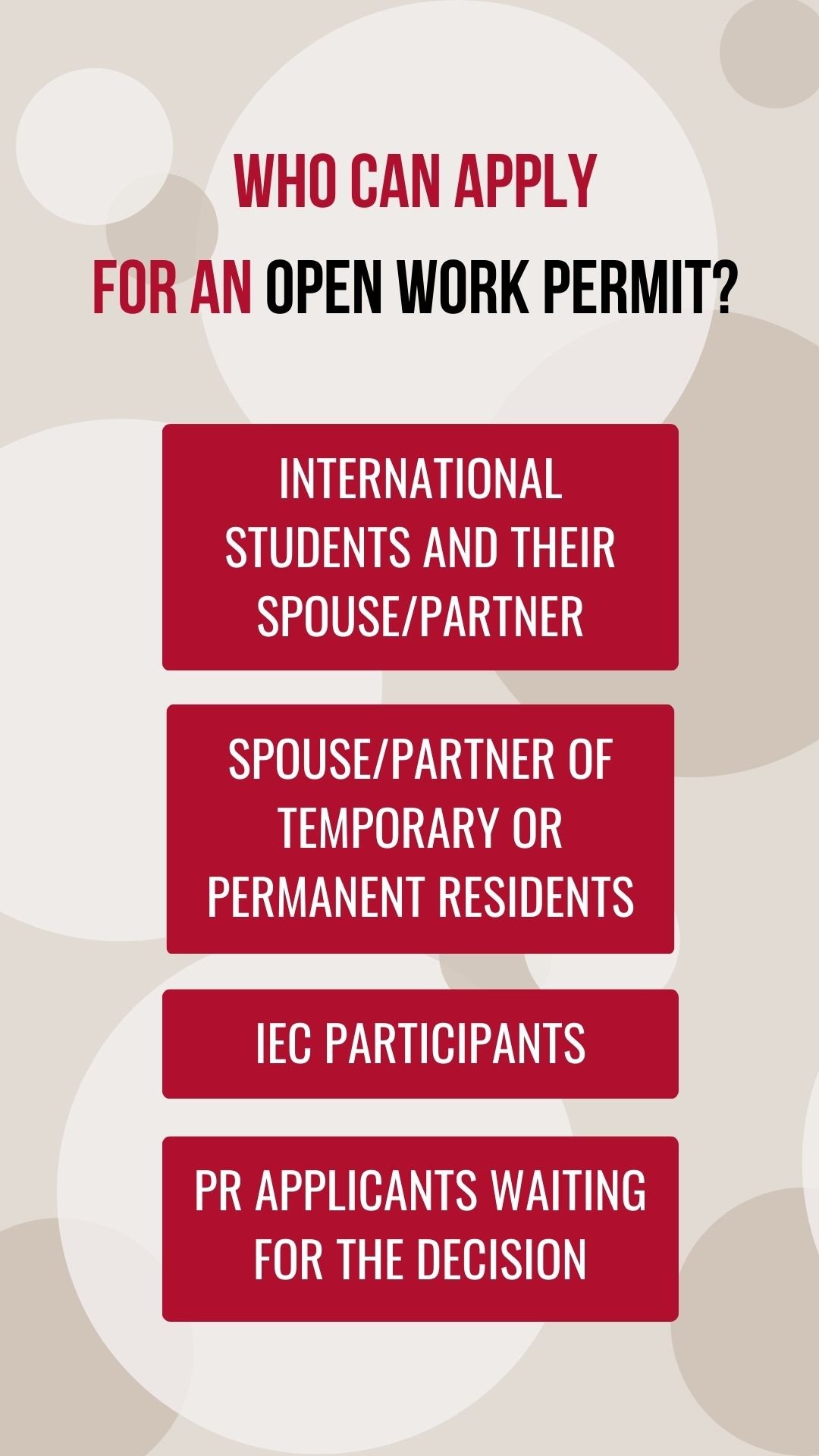
Who Qualifies for an Open Work Permit?
While this isn’t a free-for-all option, several categories of people can unlock this pathway, if they know where to look. Here’s who should be paying attention:
1. Spouses of International Students or Skilled Workers
Married to someone studying or working in Canada? You may be eligible to work full-time while living with them.
This is hands-down one of the most popular and practical ways spouses gain Canadian work experience and contribute financially during their partner’s stay.
To qualify, you’ll need to prove:
- Your spouse or common-law partner holds a valid study or work permit;
- Your relationship is legitimate (think marriage certificates, shared leases, utility bills, joint bank accounts, travel history together, you get the idea).
How to apply:
- Complete the IMM 5710 form if you’re already in Canada;
- Attach your partner’s valid permit;
- Include proof of your relationship;
- Pay the required fees (work permit + open work permit holder fee).
Bonus: You don’t need a job offer to qualify. You’re free to explore jobs across industries, pivot careers, or simply support your family, without being tied down.
2. Inland Spousal Sponsorship Applicants
If you’ve already applied for permanent residence through the Inland Spousal Sponsorship stream, you might be eligible for an OWP while your PR is still processing.
This is a brilliant workaround for applicants stuck in the “can’t work, can’t wait” limbo.
Eligibility checklist:
- You’re physically in Canada;
- A complete PR sponsorship application has been submitted;
- You hold valid temporary resident status (e.g., visitor, student, or worker).
What to include in your application:
- IMM 5710;
- Proof of your PR submission (acknowledgement of receipt, payment receipt);
- Evidence of your relationship.
Important: Don’t jump the gun. If you apply for your OWP before submitting your PR application, expect a quick refusal. Timing matters a lot.
3. Post-Graduation Work Permit (PGWP) Holders
If you recently graduated from a Designated Learning Institution (DLI) in Canada, this one’s for you.
The Post-Graduation Work Permit is an open permit that lets you work for up to three years, depending on the length of your study program.
It’s not just a ticket to work, it’s often your first step toward permanent residency through Express Entry or a Provincial Nominee Program (PNP).
What you’ll need:
- Completion of a full-time program (minimum 8 months);
- Final transcript and graduation letter;
- Application submitted within 180 days of graduation;
- A valid passport (your permit won’t exceed its expiry);
- Completed IMM 5710 form or an online application.
Remember: the PGWP is typically issued for the same duration as your program, up to a max of 3 years.
4. Bridging Open Work Permit (BOWP) Applicants
Already submitted your PR application, and your current work permit is about to expire?
The Bridging Open Work Permit lets you stay in Canada legally and keep working while you wait for your permanent residency decision. It’s a safety net designed to help you avoid falling through immigration cracks.
Who can apply:
- You’ve submitted a full PR application under one of the following:
Key criteria:
- Your current permit will expire within four months;
- You’re in Canada with valid status;
- You’ve received an AOR (Acknowledgement of Receipt).
Timing tip: Only apply within the final 4 months of your permit. Apply too soon, and it’s an automatic rejection.
5. Vulnerable Workers & Protected Persons
If you’re facing abuse in the workplace or have filed a refugee claim, Canada offers work permit options rooted in human dignity and protection.
You could be eligible for an OWP if:
- You’re experiencing physical, sexual, financial, or psychological abuse at work;
- You’ve been recognized as a protected person or Convention refugee;
- You’re part of a humanitarian and compassionate (H&C) application.
Application essentials:
- Declarations or evidence of abuse (emails, reports, statements);
- IMM 5710 or IMM 5713, depending on your case;
- Legal documents supporting your refugee or protected status.
These applications are fast-tracked and handled with sensitivity. No Labor Market Impact Assessment. No job offer. Just help when you need it most.
What Could Go Wrong? Common Mistakes to Avoid
Even though OWPs offer unmatched flexibility, many applicants get refused over avoidable errors. Let’s talk about what not to do:
Applying Too Early
Especially in inland sponsorships, if you file before your PR application is submitted, your OWP gets rejected. Always follow the right order.
Incomplete Files
Missing documents, like your partner’s valid permit or proof of relationship, are the fastest way to get denied. Double (and triple) check everything before submitting.
Permit Confusion
Not all open work permits are the same. Some come with conditions (like medical exam requirements or occupation restrictions). Know what you’re getting.
Why Open Work Permits Matter
These permits are more than just pieces of paper; they’re a lifeline. They give you the ability to:
- Work legally in Canada;
- Gain valuable experience;
- Stay financially stable;
- Keep your PR path on track.
But navigating eligibility, paperwork, and timing on your own? That’s where most people get stuck.
How VisaPath Immigration Can Help
At VisaPath Immigration, we don’t just “file your forms.” We look at your entire immigration puzzle, your goals, your history, your future, and build a strategy that fits.
Whether you’re a spouse joining a partner in Canada, a graduate building your career, or someone waiting on permanent residency, we’ll make sure your Open Work Permit application is airtight and compelling.
We know what immigration officers are looking for, and what gets overlooked.
Book your consultation today, and let’s make sure you’re working in Canada on your terms.
